
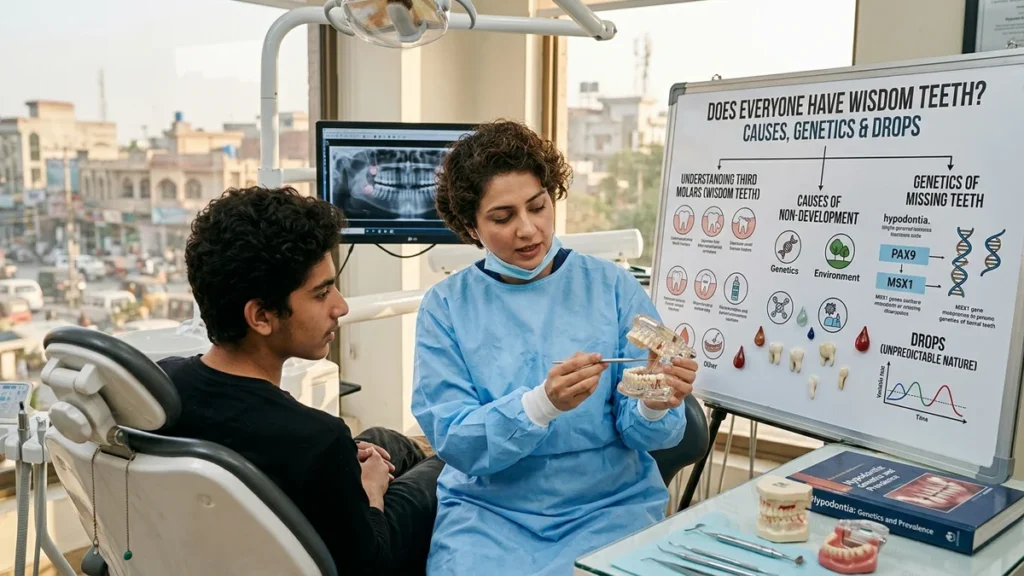
The first time a patient asked me, “Does everyone have wisdom teeth?” I realized how much confusion surrounds these mysterious third molars. In my analysis of the available evidence, I have found that WisdomTeeth are one of the most misunderstood aspects of human dental development. From my perspective, understanding why some people have them, why others don’t, and what to do when they appear requires us to explore evolution, genetics, and modern dentistry.
Based on the available evidence, not everyone has WisdomTeeth. While most people develop four wisdom teeth—one in each corner of the mouth—some people are born with fewer, and others have none at all. Let us consider the full scope of this phenomenon: WisdomTeeth are evolutionary remnants that have become increasingly unnecessary as human diets and jaw structures have changed over millions of years.
Executive Summary: What You Need to Know About Wisdom Teeth
| Aspect | Key Information |
|---|---|
| What Are Wisdom Teeth | Third molars that typically appear between ages 17 and 25 |
| Does Everyone Have Them | No. About 10-41% of people are born missing at least one wisdom tooth |
| How Many Do Most People Have | Four (two upper, two lower), but many have fewer or none |
| Why Do We Have Them | Evolutionary remnants from when early humans ate tough, raw foods |
| Impaction Rate | About 36.9% of people have at least one impacted wisdom tooth |
| Common Issues | Crowding, pain, infection, damage to adjacent teeth |
| When Removal Is Needed | When they cause problems or are likely to (about 0.1-1% risk per year for asymptomatic teeth) |
In my view, the most important takeaway is that wisdom teeth are a fascinating example of human evolution in action—and whether you have them or not is largely determined by your genes.
Understanding Wisdom Teeth: What They Are and Why We Have Them
What Are Wisdom Teeth?
Wisdom teeth, also called third molars, are the last teeth to develop in the human mouth. They are located at the very back of your jaw, with one at the end of each row of teeth. They typically don’t develop fully until the ages of 18 to 24, and it is only then that they appear—if they do at all.
The name “wisdom teeth” comes from the fact that they usually emerge during early adulthood, when a person is theoretically “wiser” than they were as a child. As one Pitt Med Magazine article notes, “Older, wiser and—toothier? You may have heard of WisdomTeeth, the permanent teeth that show up last: between ages 17 and 25, at the back of the mouth.”
Why Do We Have Wisdom Teeth?
The answer to this question takes us back several million years. Our early human ancestors had much tougher diets than we do today—they relied on things like raw meat and tough plants for nourishment. These challenging foods required big, strong jaws and large teeth to grind and chew effectively. Over time, as humans developed food preparation methods that allowed for softer, easier-to-chew foods, our jaws gradually evolved to become smaller.
Wisdom teeth are what scientists call “vestigial structures”—body parts that no longer serve a significant purpose but persist as remnants of our evolutionary past. As our jaws got smaller, there was less room for these third molars to fit comfortably. This mismatch between jaw size and tooth count is why WisdomTeeth often become impacted or fail to erupt properly.
Archaeological Evidence of Wisdom Tooth Evolution
Archaeological research has traced wisdom tooth degeneration back through human evolution. According to a study published in the Sichuan Da Xue Xue Bao Yi Xue Ban, third molar impaction can be traced back to Australopithecus from approximately 2.3 million years ago. The study found that during the Neolithic period, there was a “notable qualitative transition” when frequencies of impaction increased substantially.
Interestingly, congenital absence of wisdom teeth has been documented in Lantian Man (Homo erectus lantianensis), suggesting that humans have been evolving away from third molars for hundreds of thousands of years. Morphological abnormalities such as peg-shaped teeth and size reduction reflect “the ongoing evolutionary process of dental degeneration.” These archaeological findings provide crucial support for understanding how humans have adapted to environmental changes and dietary shifts over time.
Does Everyone Have Wisdom Teeth? The Surprising Answer
The short answer is no—not everyone has WisdomTeeth. While many people develop four wisdom teeth, studies indicate that between 10% and 41% of people are born with congenitally missing third molars, a condition called “tooth agenesis.” According to Medibank, evidence suggests around 22% of people worldwide don’t have wisdom teeth at all.
How Many Wisdom Teeth Do Most People Have?
About 80 out of 100 young adults have at least one wisdom tooth that stays inside the jaw and doesn’t break through the gums. This means that having at least one impacted wisdom tooth is actually more common than having all four fully erupt.
| Scenario | Approximate Prevalence |
|---|---|
| Born with no wisdom teeth | 10-41% |
| All four wisdom teeth | Common, but varies by population |
| At least one impacted tooth | ~80% |
| At least one impacted third molar | 36.9% globally |
Factors That Influence Whether You Have Wisdom Teeth
Genetics: This is the most significant factor. Research on twins has shown that if one identical twin doesn’t have WisdomTeeth, there’s an 80% likelihood their twin also lacks them. For non-identical twins, that rate drops to about 60%. Specific genes, including PAX9, MSX1, AXIN2, and EDA, are known to be associated with tooth agenesis. According to MedGen, mutations in the WNT10A gene are responsible for about 56% of cases of nonsyndromic tooth agenesis.
Sex: Some studies suggest that females may have a higher likelihood than males of third molar agenesis, meaning they are more likely to be born without wisdom teeth.
Race and Ethnicity: Certain populations are less likely to develop wisdom teeth. These include Indigenous Mexican, Native American, Northeast Asian, Chinese, and Malaysian people. The prevalence of impacted third molars also varies by region, with the highest rates in Asia (43.1%) and the lowest in Europe (24.5%).
Jaw Size: People with smaller facial structures may be less likely to develop wisdom teeth. This is because the evolutionary trend toward smaller jaws has made it more difficult for third molars to fit properly.
What Are Impacted Wisdom Teeth?
Not everyone who has wisdom teeth will see them fully emerge. Impacted WisdomTeeth are third molars that remain trapped in the jawbone and never break through the gums. Sometimes, a wisdom tooth partially erupts, breaking through the gum but not fully emerging.
How Common Are Impacted Wisdom Teeth?
A systematic review and meta-analysis published in 2024 found that the pooled prevalence of impacted third molars was 36.9% per subject and 46.4% per tooth, with the highest rates in Asia (43.1%) and the lowest in Europe (24.5%). The study, which included 183,828 subjects across 98 studies, also found that women have a slightly higher likelihood of third molar impaction than men, and that mandibular (lower jaw) impactions are more frequent than maxillary (upper jaw) impactions.
Why Do Wisdom Teeth Become Impacted?
Impacted WisdomTeeth typically occur because of insufficient space in the jaw. As one study notes, “The lack of space in the retromolar region, which may result from insufficient mandibular growth or a discrepancy between tooth and jaw sizes, seems to be the primary factor contributing to third molar impaction.” Other contributing factors include a narrow alveolar arch and delayed third molar maturation combined with early physical maturation.
Problems Caused by Impacted Wisdom Teeth
Impacted wisdom teeth can cause several issues:
- Pain and discomfort
- Infection (pericoronitis)
- Damage to adjacent teeth
- Crowding
- Cyst formation
- Tooth decay in the impacted tooth or neighboring teeth
It is estimated that more than 50% of the population experience problems with their third molars, including problems with the eruption process or other pathologies.
Should Wisdom Teeth Be Removed?
When Removal Is Recommended
Wisdom teeth that aren’t causing problems have only a small risk (0.1-1% per year) of developing problems in the future. However, dentists may recommend removal when they:
- Are impacted and likely to cause problems
- Have caused previous infections or pain
- Are damaging adjacent teeth
- Show signs of decay or gum disease that can’t be treated
Dental professionals also use digital tools to support clinical documentation and patient care. For a related look at technology used in dentistry, read our guide to AI tools for dental professionals.
Changing Recommendations on Wisdom Tooth Removal
Interestingly, wisdom tooth removal is less common today than it once was. The UK’s National Institute for Clinical Excellence began discouraging routine wisdom tooth removal in 2000, and in 2008, the American Public Health Association released a similar statement opposing the removal of undiseased third molars.
A 2025 YouGov survey found that while most older adults in the United States have had their wisdom teeth removed, most young adults have not. Two-thirds (67%) of Americans who turned 20 before 2000 have had their wisdom teeth removed, while only about one-third (35%) of Americans who turned 20 between 2009 and 2015 have had them removed. These generational differences align with evolving scientific views on third molar extraction.
The Age Factor in Wisdom Tooth Removal
The survey also found that other factors are associated with the prevalence of wisdom tooth removal. Women (58%) are more likely than men (46%) to have had their wisdom teeth removed, which may reflect that women are somewhat more likely to suffer from tooth crowding. There are also regional differences: Midwestern Americans (60%) are most likely to have their wisdom teeth removed, while Northeastern Americans (47%) are least likely.
Common Complications from Wisdom Tooth Extraction
A study on surgical outcomes reports that active bright red bleeding occurs in only about 2-3% of cases, while nerve injury (inferior alveolar nerve) happens in 0.5-2% of routine extractions but goes up to 8-12% in deeply impacted, difficult cases. In 85-90% of cases, the sensation returns to normal within 3-6 months. Limited mouth opening (trismus) happens to about 8-15% of patients, worst at 24-48 hours, usually resolving within 1-3 weeks.
The Genetics of Missing Wisdom Teeth
Understanding Tooth Agenesis
Tooth agenesis—the congenital absence of teeth—is a common human anomaly that affects approximately 20% of the population. The most commonly affected teeth are third molars (wisdom teeth), followed by upper lateral incisors or lower second premolars.
Genes Involved in Wisdom Tooth Development
Several genes have been identified as playing a role in tooth development and agenesis:
| Gene | Role |
|---|---|
| PAX9 | Associated with agenesis of molars |
| MSX1 | Associated with missing second premolars |
| WNT10A | Major gene in isolated hypodontia (56% of cases) |
| WNT10B | Associated with missing lateral incisors |
| EDA | Associated with X-linked tooth agenesis |
Research has shown that WNT10A is a major gene in the etiology of isolated hypodontia, with van den Boogaard et al. (2012) finding that 56% of patients with nonsyndromic tooth agenesis had mutations in WNT10A. This genetic understanding helps explain why wisdom teeth absence runs in families.
Conclusion
Throughout this exploration of wisdom teeth, I have found that these evolutionary remnants are far more complex than most people realize. The practical lesson is that not everyone has wisdom teeth, and whether you have them—and whether they cause problems—is largely determined by your genetics.
I believe the central insight is that wisdom teeth are a fascinating example of human evolution in action. As our diets and jaws have changed over millions of years, these third molars have become increasingly unnecessary. For many people, they never develop at all. For others, they appear but may not erupt properly, potentially causing problems that require removal.
From my perspective, the growing trend toward more conservative management of wisdom teeth—only removing them when they actually cause problems—reflects a better understanding of their natural history and the risks of unnecessary surgery. For those interested in exploring more about health and wellness topics, resources like those available at WordPlay-2018 can provide additional insights.
Frequently Asked Questions
Does everyone have wisdom teeth?
No, not everyone has wisdom teeth. Studies indicate that between 10% and 41% of people are born with congenitally missing third molars. Approximately 22% of people worldwide don’t have wisdom teeth at all.
How many wisdom teeth do most people have?
Most people have four WisdomTeeth—one in each corner of the mouth. However, about 80 out of 100 young adults have at least one wisdom tooth that doesn’t break through the gums. Many people are born with fewer than four.
Why do some people not have wisdom teeth?
Several factors contribute to missing WisdomTeeth, including genetics, sex, race and ethnicity, and jaw size. Specific genes like PAX9, MSX1, and WNT10A are associated with tooth agenesis. If one identical twin lacks WisdomTeeth, there’s an 80% likelihood the other twin also lacks them.
What percentage of people have impacted wisdom teeth?
About 36.9% of people have at least one impacted wisdom tooth. The prevalence varies by region, with the highest rates in Asia (43.1%) and the lowest in Europe (24.5%).
Do wisdom teeth always need to be removed?
No. Wisdom teeth that aren’t causing problems have only a 0.1-1% annual risk of developing problems in the future. Major dental organizations now discourage routine removal of undiseased WisdomTeeth.
At what age do wisdom teeth appear?
Wisdom teeth typically appear between ages 18 and 24, though they can emerge later or not at all. The name “wisdom teeth” comes from the fact that they usually appear during early adulthood.
Are women more likely to have wisdom teeth problems?
Women are slightly more likely than men to have impacted WisdomTeeth (odds ratio of 1.173). Women (58%) are also more likely than men (46%) to have had their WisdomTeeth removed, which may reflect that women are somewhat more likely to suffer from tooth crowding.
Why did humans evolve to have wisdom teeth?
Wisdom teeth evolved because early human ancestors needed large jaws and teeth to chew tough, raw foods. As humans developed food preparation methods and softer diets, jaws gradually became smaller, leaving less room for these third molars. WisdomTeeth are vestigial structures from this evolutionary past.
Sources
- “Overview: WisdomTeeth – Introduction.” National Institutes of Health (NIH), 2023.
- Pinto, A.C., Francisco, H., Marques, D., Martins, J.N.R., & Caramês, J. “Worldwide Prevalence and Demographic Predictors of Impacted Third Molars—Systematic Review with Meta-Analysis.” Journal of Clinical Medicine, 13(24), Article 7533, 2024.
- Huang, H., Zhou, J., & Zhou, X. “Archeological Research on Third Molar Degeneration.” Sichuan Da Xue Xue Bao Yi Xue Ban, 56(6):1715-1720, 2025.
- Hayes, Alexander Rossell. “Young American adults challenge the conventional wisdom on tooth removal.” YouGov, July 2025.
- Sarkar, T., Bansal, R., & Das, P. “Identification and characterization of disease causing genetic variant by conventional genotyping and whole genome sequencing in familial tooth agenesis.” Molecular Cytogenetics, 7(Suppl 1):P26, 2014.
- “Does everyone have WisdomTeeth?” Medical News Today, 2025.
- “Worldwide Prevalence and Demographic Predictors of Impacted Third Molars—Systematic Review with Meta-Analysis.” MDPI, 2024.
- Letra, A. & Weinberg, S. “Tween science: Why do we have WisdomTeeth?” Pitt Med Magazine, 2024.
- “Wisdom Teeth Extraction: Indications, Surgical Protocols.” DentalPedia, 2026.
- “Primary failure of tooth eruption.” MedGen, National Institutes of Health.
- “Do I have to remove my WisdomTeeth?” Medibank, 2026.
- “Worldwide Prevalence and Demographic Predictors of Impacted Third Molars—Systematic Review with Meta-Analysis.” Universidade de Lisboa, 2025.
- “Archeological Research on Third Molar Degeneration.” Sichuan University, 2025.
- “Clinical Protocol: Surgical Success Rates Across Oral Surgery.” DentalPedia, 2026.
- “Williams syndrome.” MedGen, National Institutes of Health.
Disclaimer
This article provides general information about wisdom teeth for informational and educational purposes. The analysis is based on available public information and may not reflect the most current medical guidelines or practices. This article does not constitute professional dental or medical advice. Always seek the advice of your dentist or other qualified health provider with any questions you may have regarding a medical condition or treatment.

Faizullah Baig
Entertainment & Digital Culture Writer at WordPlay2018
Faizullah Baig is a writer at WordPlay2018 covering entertainment, celebrity news, movies, television, pop culture, and digital trends.
His work focuses on explaining current entertainment stories in a clear and reader-friendly way, with attention to the details behind trending headlines.
Areas of Coverage
Faizullah primarily covers:
Celebrity news and profiles
Movies and television
Entertainment industry developments
Celebrity relationships and public appearances
Trending pop-culture stories
Digital culture and online trends
Editorial Approach
Faizullah aims to distinguish confirmed information from reports, estimates, and speculation. For developing stories, information may be updated as additional reliable details become available.
Articles published under his name are intended to provide readers with useful context rather than simply repeat a headline or social-media claim.
Contact
For corrections, questions, or feedback about an article published under Faizullah Baig’s name, please contact:
Publication: WordPlay2018
Role: Entertainment & Digital Culture Writer