
I believe that understanding how long nicotine stays in your system is one of the most practical pieces of health knowledge anyone can possess. Whether you are preparing for a medical test, considering quitting smoking, or simply curious about what happens inside your body after your last cigarette, the answer matters. In my analysis, the question seems straightforward, but the reality is layered.
Nicotine itself clears the bloodstream within hours, yet its primary metabolite, cotinine, lingers for days. Hair tests can detect exposure for months. The detection window depends entirely on the test used and the individual being tested.
From my perspective, the confusion surrounding this topic stems from a failure to distinguish between nicotine and its breakdown products. People often ask how long nicotine stays in the body and receive answers that actually describe cotinine. We can see this confusion play out in online forums, where conflicting claims range from three days to three months. The truth is that both answers can be correct, depending on what is being measured and how. For more engaging content on health, lifestyle, and culture, you can also visit Wordplay 2018.
Key Takeaways: The Essential Facts About Nicotine Detection
Before we examine the details, I want to summarize the most important principles that will guide our discussion. First, nicotine itself has a half-life of approximately two hours and clears the bloodstream within one to three days. Second, cotinine, the primary metabolite, has a half-life of sixteen to twenty hours and remains detectable for up to ten days in heavy users. Third, urine, blood, saliva, and hair tests each have different detection windows. Fourth, genetics play a significant role in how quickly your body metabolizes nicotine. Fifth, no proven method exists to dramatically accelerate nicotine elimination. Finally, understanding these timelines helps you make informed decisions about testing and health.
Nicotine vs. Cotinine: Why the Distinction Matters
Let us consider the fundamental difference between nicotine and cotinine. Nicotine is the addictive chemical found in tobacco and nicotine replacement products. When you inhale, chew, or absorb nicotine, it enters your bloodstream rapidly and reaches your brain within seconds. The feeling of alertness and reward that follows is what drives repeated use. However, nicotine does not remain in its original form for long. The liver metabolizes it, primarily through an enzyme called CYP2A6, converting up to ninety percent of it into cotinine.
Cotinine is not merely a waste product. It has pharmacological effects of its own, though researchers continue to study their exact nature. What matters for our purposes is that cotinine remains in the body far longer than nicotine. Its average half-life is sixteen to nineteen hours, compared to nicotine’s one to two hours. This longer half-life is precisely why cotinine is the preferred marker for detecting nicotine exposure. When a laboratory tests for tobacco use, it almost always looks for cotinine, not nicotine itself.
This distinction has practical implications. If someone asks how long nicotine stays in the system, the honest answer depends on whether they mean nicotine or cotinine. Nicotine clears relatively quickly. Cotinine lingers. Hair tests complicate the picture further by capturing long-term exposure. I believe that recognizing this difference is the first step toward understanding any detection timeline.
How Long Does Nicotine Stay in Your System? Detection Times by Test Type
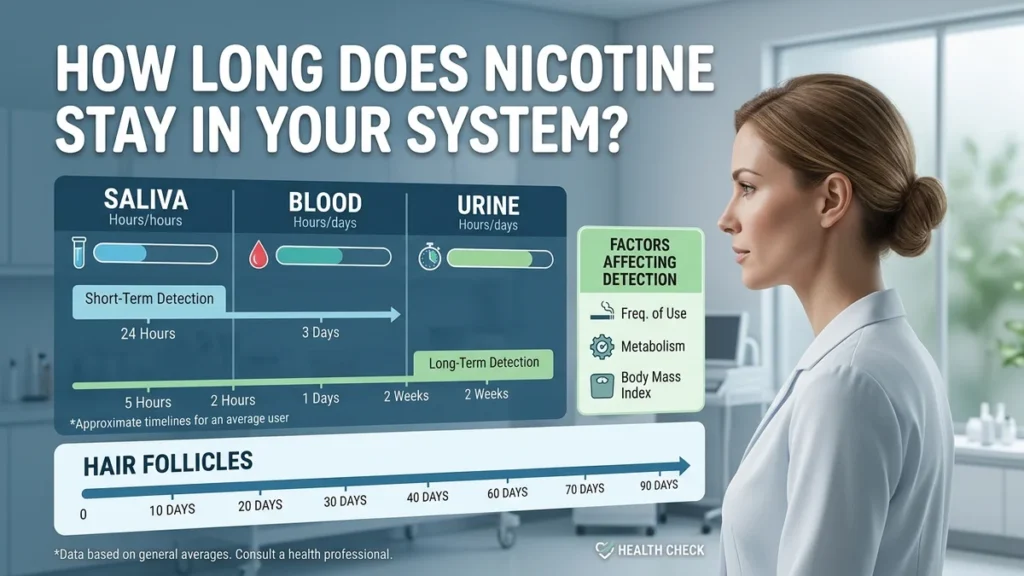
I have found that the most useful way to answer this question is to break it down by test type. Each biological sample offers a different detection window, and each has advantages and limitations. Let us examine each one in detail.
Urine Testing: The Most Common Screening Method
Urine testing is the most widely used method for detecting nicotine exposure. It is non-invasive, relatively inexpensive, and offers a reasonable detection window. According to clinical data, nicotine can be detected in urine for two to three days after the last use. Cotinine, however, remains detectable for two to four days in occasional users and up to ten days in heavy users. Some research suggests that urine tests may detect nicotine or related substances for even longer periods.
The variability in urine detection times reflects the influence of individual factors. Someone who smokes occasionally will clear cotinine more quickly than a pack-a-day smoker. Hydration levels also affect the concentration of cotinine in urine, though they do not dramatically change the detection window. A highly hydrated person will produce more dilute urine, which may push the detection threshold slightly lower, but the cotinine remains present.
Blood Testing: Precise but Short-Lived
Blood testing offers the most precise measurement of nicotine and cotinine levels, but its detection window is shorter than urine. Nicotine itself is measurable in the blood for only a few hours after exposure because it breaks down so rapidly. Cotinine, however, remains detectable in the blood for one to three days in light users and up to ten days in heavy users. Harvard Health notes that cotinine levels drop by fifty percent approximately every eighteen to twenty hours.
The short detection window for nicotine in blood makes it a poor marker for long-term exposure. Researchers and clinicians prefer cotinine for this purpose. A blood test can distinguish between someone who used nicotine within the past day and someone who used it a week ago, provided the levels are interpreted correctly. However, the exact concentration depends on the amount and frequency of use, making it difficult to establish universal thresholds.
Saliva Testing: Sensitive and Non-Invasive
Saliva testing has gained popularity because it is non-invasive and relatively easy to administer. Nicotine can remain detectable in saliva for up to four days after the last use. Cotinine, the more stable metabolite, remains detectable for four to seven days. Saliva tests are highly sensitive and can detect even low-level exposure, including secondhand smoke.
From my perspective, saliva testing occupies a useful middle ground. It offers a longer detection window than blood while being less invasive than urine collection. However, saliva tests can be affected by recent food or drink consumption, and they may produce false positives if the person has recently used nicotine replacement products. The test detects nicotine and cotinine, but it cannot distinguish between tobacco and nicotine replacement therapy unless additional markers such as anabasine are included.
Hair Follicle Testing: The Longest Detection Window
Hair follicle testing offers the longest detection window of any method. Nicotine and cotinine can be detected in hair for up to ninety days after the last use. In some cases, depending on the length of the hair and the extent of exposure, detection may extend even further. Hair grows approximately one centimeter per month, and nicotine metabolites are deposited in the hair shaft as it grows. By analyzing segments of hair, testers can estimate not only whether someone used nicotine but also approximately when they used it.
Hair testing is the most reliable method for determining long-term nicotine use. It is also the most invasive in terms of privacy, though the sample collection itself is painless. I believe that anyone facing a hair test should understand that traces of nicotine can remain detectable for months, far longer than any other testing method.
Table 1: Nicotine and Cotinine Detection Times by Test Type
The following table provides a comprehensive reference for detection times across the four primary testing methods. I have designed this table to help you understand which test offers the longest window and how nicotine and cotinine differ in each sample type.
| Test Type | Nicotine Detection Time | Cotinine Detection Time |
|---|---|---|
| Urine | 2–3 days | 2–4 days (up to 10 days for heavy users) |
| Blood | 1–3 days | Up to 10 days |
| Saliva | 1–4 days | 4–7 days |
| Hair | Up to 90 days | Up to 90 days (potentially longer) |
The most important takeaway from this table is that the detection window varies dramatically by test type. Urine and blood tests capture recent use within a few days. Saliva tests extend slightly further. Hair tests capture months of exposure. If you are preparing for a specific type of test, knowing which sample will be collected is essential to understanding your timeline.
Factors That Affect How Long Nicotine Stays in Your System
I have found that individual variation in nicotine metabolism is substantial. Two people can use the same amount of nicotine and experience wildly different detection windows. Let us examine the most significant factors that influence how long nicotine and cotinine remain in the body.
Genetics and the CYP2A6 Enzyme
Genetics play a major role in nicotine metabolism. The CYP2A6 enzyme, produced in the liver, is responsible for converting nicotine to cotinine and then cotinine to other metabolites. Variations in the CYP2A6 gene affect how efficiently this enzyme works. Some people are fast metabolizers, meaning they clear nicotine and cotinine quickly. Others are slow metabolizers, meaning these substances remain in their systems longer.
Research published by the CDC indicates that approximately sixty percent of the variation in nicotine metabolism is due to genetic factors. Slow metabolizers tend to have longer detection windows, while fast metabolizers clear nicotine more rapidly. This genetic variation also influences smoking behavior. Slow metabolizers often smoke fewer cigarettes per day because nicotine remains in their systems longer, reducing the urge to smoke frequently. Fast metabolizers, by contrast, tend to smoke more heavily to maintain the desired level of nicotine.
Frequency and Duration of Use
The frequency and duration of nicotine use directly affect detection times. An occasional smoker who has one cigarette will clear cotinine within a few days. A heavy smoker who consumes twenty or more cigarettes daily will accumulate higher levels of cotinine, and the elimination process will take longer. Cotinine can remain detectable for up to ten days in heavy users, compared to three or four days in light users.
The type of nicotine product also matters. Smokeless tobacco, such as chewing tobacco or snus, delivers nicotine over a longer period than smoking. This extended absorption can lead to higher sustained levels of cotinine, potentially lengthening the detection window. Nicotine replacement products, including gum, patches, and lozenges, also contribute to cotinine levels, though some tests can distinguish between tobacco and replacement therapy.
Age, Sex, and Body Composition
Age affects nicotine metabolism. As people get older, their metabolic rate tends to slow, which can extend the detection window. Sex also plays a role. Women, particularly those who are pregnant or taking estrogen-containing medications, tend to clear nicotine faster than men. Body composition has a more modest effect. Body weight influences how nicotine is distributed in the body, but its impact on elimination speed is less significant than genetics or frequency of use.
Hydration, Diet, and Physical Activity
Hydration status can influence the concentration of cotinine in urine. Drinking plenty of water dilutes the urine and supports kidney function, which helps the body eliminate waste products. However, hydration alone will not dramatically accelerate the elimination of nicotine or cotinine. It supports the body’s natural processes but does not override the half-life of the metabolites.
Diet also plays a supporting role. Antioxidant-rich foods, including fruits and vegetables, may help support liver function and overall detoxification. Physical activity boosts metabolism and circulation, which can modestly support the elimination process. High-intensity interval training, in particular, has been suggested to increase metabolic rate and potentially speed the clearance of nicotine byproducts. That said, no dietary or exercise intervention has been proven to flush nicotine from the body overnight.
Table 2: Factors Influencing Nicotine Detection Windows
The following table summarizes the primary factors that affect how long nicotine and cotinine remain detectable. I have included this table to help you assess your own likely detection window based on your personal circumstances.
| Factor | Effect on Detection Window | Notes |
|---|---|---|
| Genetics (CYP2A6) | Slow metabolizers have longer windows | Up to 60% of variation is genetic |
| Frequency of use | Heavy users have longer windows | Cotinine detectable up to 10 days |
| Type of product | Smokeless tobacco may extend window | NRT also produces cotinine |
| Age | Older individuals may clear more slowly | Effect is moderate |
| Sex | Women may clear faster than men | Hormonal factors involved |
| Hydration | Minimal effect on detection | Supports kidney function |
| Exercise | Modest supporting effect | Boosts metabolism and circulation |
The most important takeaway from this table is that genetics and frequency of use are the dominant factors. A heavy smoker with slow-metabolizing genetics will have a significantly longer detection window than an occasional user with fast-metabolizing genetics. Hydration and exercise offer only modest support and should not be relied upon as primary strategies for passing a nicotine test.
How Nicotine Replacement Therapy Affects Detection Times
Let us consider the impact of nicotine replacement therapy on detection windows. Products such as nicotine gum, patches, lozenges, and nasal sprays deliver nicotine to the body, which means they also produce cotinine. If you are using these products to quit smoking, you will continue to test positive for cotinine even though you are no longer using tobacco.
This distinction matters in certain testing contexts. A standard cotinine test cannot differentiate between tobacco use and nicotine replacement therapy. However, some comprehensive tests include a marker called anabasine. Anabasine is a substance present in tobacco but absent from nicotine replacement products. If a comprehensive test returns a positive result for anabasine, it indicates tobacco use. If anabasine is absent but cotinine is present, the result suggests nicotine replacement therapy.
From my perspective, this is an important nuance for anyone using nicotine replacement to quit smoking. You are making a positive health decision, but you may still test positive for nicotine exposure. Understanding the difference between standard and comprehensive testing helps you anticipate and interpret results correctly.
“There is no way to flush it out of your system faster.”
— Benjamin Toll, Director of the Tobacco Treatment Program at the Medical University of South Carolina, in an interview with The Detroit News
This quotation from Benjamin Toll is directly relevant to our discussion because it addresses a common misconception. Many people believe that drinking excessive water, exercising vigorously, or following a special diet can rapidly eliminate nicotine from the body. Toll’s statement makes clear that no such shortcut exists. The body metabolizes nicotine and cotinine at its own pace, determined primarily by genetics and individual physiology. In my view, the practical lesson is that time is the only reliable factor in clearing nicotine from the system. Attempting to accelerate the process through extreme measures is unlikely to produce meaningful results.
Common Myths About Clearing Nicotine From the Body
I believe that misinformation about nicotine elimination is widespread, and it is worth addressing the most persistent myths directly. Let us examine several claims that circulate online and assess their validity based on available evidence.
The first myth is that drinking large amounts of water flushes nicotine from the system. Hydration supports kidney function and helps dilute urine, but it does not change the half-life of cotinine. The body eliminates cotinine at a predetermined rate that cannot be significantly accelerated by increased water intake. Staying hydrated is healthy, but it is not a detox strategy.
The second myth is that intense exercise dramatically speeds nicotine elimination. Exercise boosts metabolism and circulation, which can support the body’s natural detoxification processes. However, the effect is modest. A thirty-minute workout may increase metabolic rate temporarily, but it will not erase days of cotinine accumulation. Exercise is beneficial for overall health, but it should not be viewed as a rapid detox solution.
The third myth is that certain foods or supplements can flush nicotine from the body. Antioxidant-rich foods support liver health and overall well-being, but no food or supplement has been proven to accelerate nicotine metabolism in a clinically significant way. Claims about specific detox foods are generally unsupported by rigorous evidence.
The fourth myth is that nicotine leaves the body within three days in all cases. As we have seen, this is only true for the nicotine molecule itself in light users. Cotinine remains detectable for much longer, and hair tests can capture exposure for months. Anyone relying on the three-day figure may be surprised by a positive test result.
Expert Recommendations for Understanding Your Detection Window
I recommend that anyone concerned about nicotine detection begin by identifying which test they are likely to face. Urine and blood tests have shorter windows, while hair tests have the longest. If you are preparing for a hair test, no short-term strategy will help, because the detection window extends back months. If you are preparing for a urine or blood test, your best approach is to allow as much time as possible between your last nicotine use and the test.
From what the research shows, the most reliable way to ensure a negative test result is to stop using all nicotine products and wait. The waiting period depends on your individual metabolism, frequency of use, and the test type. A light user might clear cotinine within three to four days. A heavy user might need up to ten days. For hair tests, the only way to avoid detection is to have stopped using nicotine at least ninety days before the sample is collected.
“The best way to clear nicotine is to stop using nicotine products in any form, and remove all exposures including secondhand smoke.”
— Medical expert quoted by Medical News Today
This quotation reinforces the fundamental principle that cessation is the only reliable path to a nicotine-free system. Secondhand smoke exposure can also contribute to cotinine levels, so eliminating all sources of nicotine is essential. In my view, this advice applies whether you are trying to pass a test, improve your health, or simply understand your body’s relationship with nicotine.
Step-by-Step: Estimating Your Personal Detection Timeline
Let us walk through a practical process for estimating your own detection timeline. I have organized this as a sequential guide that you can apply to your specific situation.
Step 1: Identify Your Test Type
Determine which biological sample will be tested. Urine and blood tests have the shortest windows. Saliva tests extend slightly further. Hair tests capture the longest period. If you do not know the test type, assume the longest window and plan accordingly.
Step 2: Assess Your Usage Frequency
Classify yourself as a light, moderate, or heavy user. Light users typically consume fewer than five cigarettes or nicotine doses per day. Moderate users consume five to fifteen. Heavy users consume more than fifteen. The higher your usage, the longer your detection window.
Step 3: Consider Your Genetic Profile
If you know your CYP2A6 metabolizer status, factor it into your estimate. Slow metabolizers should add several days to their expected detection window. Fast metabolizers can subtract a few days. If you do not know your status, assume an average metabolic rate.
Step 4: Calculate Your Window
Use the tables in this article to calculate your expected detection window. 1. For a moderate user facing a urine test, expect cotinine to remain detectable for five to seven days. 2. For a heavy user facing a blood test, expect up to ten days. 3. For any user facing a hair test, expect ninety days.
Step 5: Plan Your Cessation Date
Work backward from your test date to determine when you need to stop using nicotine. Allow a buffer of several extra days to account for individual variation. If your calculated window is seven days, stop using nicotine at least ten days before the test.
Conclusion
Understanding how long nicotine stays in your system is a matter of knowing what is being measured and how. I believe that the most useful finding from this analysis is that nicotine and cotinine are not the same thing, and their detection windows differ substantially. Nicotine clears the bloodstream within one to three days. Cotinine remains detectable for up to ten days in heavy users. Hair tests extend the window to ninety days or more.
In my view, the practical lesson for anyone concerned about nicotine detection is to focus on the factors you can control. Stop using all nicotine products as early as possible. Eliminate exposure to secondhand smoke. Stay hydrated and maintain a healthy lifestyle to support your body’s natural detoxification processes. Accept that no shortcut exists to accelerate elimination beyond what your metabolism already dictates. My advice is to use the tables in this article to estimate your personal detection window, then plan your cessation date with a generous buffer. The more time you allow, the more confident you can be in your result.
Frequently Asked Questions
How long does nicotine stay in your system after one cigarette?
After a single cigarette, nicotine itself clears the bloodstream within one to three days. Cotinine, the primary metabolite, remains detectable for approximately two to four days in urine and blood tests. Saliva tests may detect cotinine for four to seven days. Hair tests, however, can detect exposure for up to ninety days, even after a single use.
Can secondhand smoke cause a positive nicotine test?
Yes, secondhand smoke exposure can cause a positive nicotine test. Cotinine is produced by the body when it metabolizes nicotine, and secondhand smoke contains enough nicotine to trigger cotinine production. The levels are typically lower than those from active smoking, but they can still exceed detection thresholds. Avoiding all smoke exposure is the only way to ensure a negative result.
Does vaping affect how long nicotine stays in your system?
Vaping delivers nicotine to the body in a manner similar to smoking, so the detection timeline is comparable. Nicotine clears within one to three days, and cotinine remains detectable for up to ten days in heavy users. The type of device and the nicotine concentration in the e-liquid affect how much nicotine enters the body, which in turn influences the detection window.
Can I pass a nicotine test by drinking water?
Drinking water supports kidney function and helps dilute urine, but it does not significantly accelerate the elimination of nicotine or cotinine. The half-life of cotinine is determined primarily by genetics and liver enzyme activity, not by hydration status. While staying hydrated is healthy, it will not allow you to pass a nicotine test if you have recently used nicotine.
How long does nicotine stay in your hair?
Nicotine and cotinine can be detected in hair for up to ninety days after the last use. In some cases, depending on the length of the hair and the extent of exposure, detection may extend even further. Hair grows approximately one centimeter per month, and nicotine metabolites are deposited in the hair shaft as it grows. Hair testing is the most reliable method for determining long-term nicotine exposure.
Sources and References
- Recovered.org. “How Long Does Nicotine Stay in Your System?” Recovered.org, 2026.
- Allen Carr’s Easyway. “How long does nicotine stay in your system?” AllenCarr.com, 2024.
- Drugs.com. “How long does nicotine stay in your system? Detection times and testing.” Drugs.com, 2025.
- Harvard Health. “How long after using nicotine can a blood test still detect it?” Health.Harvard.edu, 2010.
- Health.com. “How Long Does Nicotine Stay in Your System?” Health.com, 2025.
- CDC. “The CYP2A6 Gene and the Nicotine Metabolite Ratio.” CDC.gov, 2024.
- Medical News Today. “How long does nicotine stay in a person’s system?” MedicalNewsToday.com, 2020.
- The Detroit News. “Is there a way to flush nicotine out of your system faster?” DetroitNews.com, 2024.
Disclaimer
This article is for informational and educational purposes only. The detection times, half-lives, and physiological details described are based on publicly available medical and scientific sources. Individual results may vary depending on genetics, frequency of use, product type, and other factors. This article does not provide medical advice, and readers should consult qualified healthcare professionals for personal guidance regarding nicotine use, cessation, or testing. The quotations included are attributed to their original sources and are reproduced for commentary and educational purposes. The author has no affiliation with any of the organizations or individuals mentioned.