
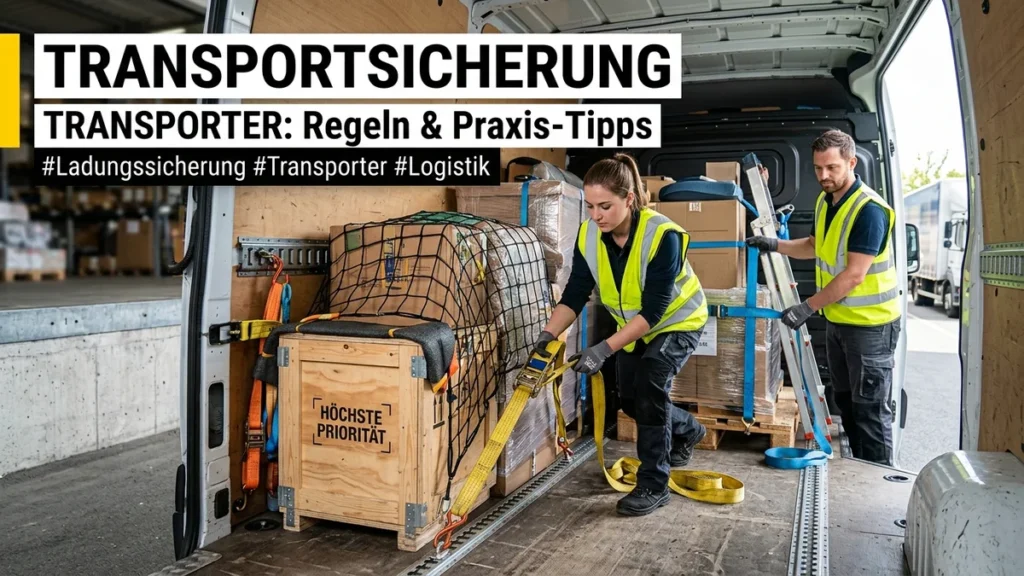
Transportsicherung Transporter: When I look at transport safety, I see one issue that deserves much more attention than it usually gets: how cargo is secured inside and on a transporter. A vehicle can be mechanically sound, the driver can be careful, and the route can look completely ordinary, yet poorly secured cargo can still create a serious hazard within seconds.
The German term Transportsicherung Transporter describes the practical work of securing loads carried by a transporter or similar commercial vehicle. It is not simply about putting boxes, tools, machines, furniture, or other goods into a cargo area. The load has to remain controlled during normal driving conditions and during situations such as heavy braking, sudden steering, uneven roads, or evasive manoeuvres.
I believe the most useful way to understand this subject is to combine the legal requirements with practical loading habits. A rule alone does not secure a pallet, and a lashing strap alone does not guarantee a safe load. The result comes from choosing the right method, checking the equipment, distributing weight correctly, and making sure the cargo cannot move in a dangerous way.
This guide explains the main principles behind Transportsicherung Transporter, including German road-traffic requirements, responsibilities, load distribution, lashing equipment, practical securing methods, common mistakes, and a step-by-step inspection routine.
Key Takeaways for Transportsicherung Transporter
The most important lessons can be summarized quite simply:
- Cargo must be secured so that it does not create a danger during normal traffic conditions.
- German StVO §22 specifically addresses the securing of loads and loading equipment.
- Full braking and sudden evasive movements must be considered when evaluating load security.
- The driver has an important checking responsibility, even when someone else loaded the vehicle.
- Load distribution matters before any strap is tightened.
- Form-fit securing can reduce the amount of movement that needs to be controlled.
- Lashing straps, anti-slip materials, edge protectors, and other equipment must be suitable for the load and used correctly.
- Damaged securing equipment should not be used.
- Small loose objects can also become dangerous projectiles during emergency braking.
- Special rules can apply to dangerous goods, unusual loads, and particular transport situations.
I would therefore treat load securing as a complete process rather than as the final step after loading.
What Does Transportsicherung Transporter Mean?
Transportsicherung Transporter refers to securing goods during transport in or on a transporter. The goal is to prevent the load from moving in ways that could endanger people, damage the cargo, affect vehicle stability, or create problems for other road users.
Cargo can move in several directions. It can slide forward when the vehicle brakes, move sideways during cornering, shift backward during acceleration, roll when it is cylindrical, or tip when its center of gravity is high.
That means securing cargo is not simply a matter of asking whether the load looks stable while the vehicle is parked.
A load that appears completely secure in a stationary vehicle may behave very differently when the vehicle suddenly stops. The forces created by braking or steering can turn ordinary objects into significant hazards.
German road-traffic rules address this directly. Section 22 of the German Road Traffic Regulations, the StVO, states that cargo and the equipment used for securing it must be stowed and secured so that they cannot move, fall over, roll, fall from the vehicle, or create avoidable noise even during full braking or sudden evasive movement.
The important point for me is the phrase covering emergency situations. Good load securing should not be designed only for a smooth journey. It should account for situations in which the driver has to react quickly.
“Die Ladung einschließlich Geräte zur Ladungssicherung sowie Ladeeinrichtungen sind so zu verstauen und zu sichern, dass sie selbst bei Vollbremsung oder plötzlicher Ausweichbewegung nicht verrutschen, umfallen, hin- und herrollen, herabfallen oder vermeidbaren Lärm erzeugen können.” — German StVO §22
This legal principle provides a useful practical test: What would happen to the load if the driver suddenly had to brake hard?
If the answer is uncertain, the load deserves another inspection.
Why Load Securing Matters in Everyday Transport
Many people associate load securing with large trucks, industrial pallets, or long-distance freight. In reality, transporter loads can create problems even on short journeys.
A small commercial transporter might carry:
- Hand tools
- Construction materials
- Boxes
- Furniture
- Electrical equipment
- Spare parts
- Garden equipment
- Machines
- Retail goods
- Office equipment
- Sports equipment
- Packaging materials
Some of these items are heavy, while others are surprisingly light. Weight alone does not determine the risk.
A relatively small metal object can cause injury if it travels forward during hard braking. A tall stack can tip even when its total weight is moderate. A box can slide across a smooth cargo floor if there is insufficient friction or restraint.
DGUV guidance also emphasizes that securing requirements depend on the cargo and the design of the vehicle. Normal traffic conditions include events such as full braking, sudden evasive movements, and uneven road surfaces.
I find this particularly useful because it changes the way I think about the subject. Instead of asking, “Is this load heavy enough to need a strap?” I would ask, “Can this load move in a dangerous way if something unexpected happens?”
That is a much better safety question.
German Rules Behind Transportsicherung Transporter
Transportsicherung Transporter: German load-security requirements are not based on one simple rule or one universal strap configuration. Several legal and technical principles can be relevant depending on the vehicle, cargo, and transport situation.
StVO §22 and the Load
Section 22 of the StVO is one of the central provisions for load securing. It requires the load, including securing equipment and loading equipment, to be arranged and secured so that it does not create the prohibited movements or hazards described in the regulation.
The rule also refers to recognized technical standards and rules of technology.
This means that practical load securing cannot be reduced to a single formula that applies identically to every transporter.
StVZO §31 and Vehicle Operation
Section 31 of the German Road Traffic Licensing Regulations, StVZO, also matters because the vehicle owner or responsible party must not permit operation when the vehicle, driver, load, or occupants do not meet the applicable requirements or when traffic safety is compromised.
For me, this highlights an important distinction: load securing is not only a driver’s last-minute responsibility. The organization around the vehicle also matters.
Recognized Technical Rules
DGUV materials refer to technical standards and rules that can support correct load securing, including the VDI 2700 series and DIN EN 12195 standards.
The exact standard or method needed depends on the transport situation. Therefore, I would not use a generic internet checklist as a substitute for the technical requirements applicable to a particular load.
Who Is Responsible for Load Security?
One of the most common misunderstandings is that only the driver is responsible.
In practice, responsibility can involve several people. DGUV information identifies a chain that can include the vehicle owner or holder, managers, people involved in loading, and the driver.
That makes sense because different people can control different parts of the process.
The person ordering the transport may know what is being carried. The person loading the vehicle controls how the cargo is arranged. The driver controls whether the vehicle is actually taken onto the road.
DGUV guidance also explains that the driver should check the load and securing arrangements and may need to refuse to drive when the load is not safely secured.
“Verantwortung für die Ladungssicherheit” — DGUV Information 205-024.
I see this as a useful reminder that safe transport is a shared process. A good system should not depend on one person discovering every problem immediately before departure.
Load Distribution Comes Before Lashing
One of the easiest mistakes is to place cargo wherever there happens to be space and then try to fix the arrangement with straps.
I would reverse that thinking.
First, consider:
- What is the heaviest cargo?
- Where is the vehicle’s permitted load area?
- How high is the center of gravity?
- Can the cargo move forward?
- Can it move sideways?
- Can it roll or tip?
- Can lighter items be crushed by heavier items?
- Does the arrangement affect vehicle balance?
DGUV guidance emphasizes the importance of a load distribution plan. It also notes that the center of gravity should generally be kept as low as possible and near the longitudinal centerline of the vehicle.
This is one reason I do not consider “more straps” to be a complete solution. If the load is poorly distributed, securing equipment may not solve every stability problem.
Practical Load Distribution Example
Imagine a transporter carrying several heavy machines, cartons of accessories, and lightweight packaging.
A poor arrangement could place the heaviest machines at one extreme of the cargo area and stack lighter boxes high above them. Even if the boxes are strapped, the overall arrangement may not be ideal.
A more controlled approach would consider the weight and position of the machines first, keep the center of gravity as appropriate for the vehicle, and then arrange lighter items around the stable base.
This is a hypothetical example, not a documented case study. Its purpose is simply to demonstrate how load planning affects the securing process.
Form-Fit and Force-Fit Load Securing
Two important concepts in load securing are form-fit and force-fit methods.
Form-fit securing aims to prevent movement by positioning the cargo so that it is tightly contained by suitable boundaries, blocking systems, or other structural arrangements.
Force-fit securing uses lashing forces to press or restrain the load so that friction and restraint help prevent movement.
The correct method depends on the cargo, vehicle, equipment, and securing arrangement.
DGUV guidance identifies form-fit arrangements as particularly useful and explains that additional lashing may be required when the vehicle body cannot absorb the relevant forces.
I think the simplest practical distinction is this:
- Form-fit: stop the load from having room to move.
- Force-fit: use suitable securing forces to control movement.
- Combined approach: use both where appropriate.
In real transport situations, a combination can be more practical than relying on one technique alone.
Choosing the Right Securing Equipment
The equipment used for Transportsicherung Transporter should match the load and the securing method.
Common equipment can include:
- Lashing straps
- Anti-slip mats
- Edge protectors
- Blocking bars
- Partition systems
- Cargo nets
- Chains for suitable heavy-duty applications
- Anchoring points
- Load restraint rails
- Suitable protective materials
The key word is suitable.
A strap is not automatically appropriate just because it is available. The condition, rated capacity, method of use, anchorage point, angle, and cargo characteristics all matter.
DGUV guidance recommends inspecting lashing straps before use and replacing damaged straps rather than continuing to use them.
Equipment Checklist
| Equipment | Main purpose | What I would check |
|---|---|---|
| Lashing straps | Restrain suitable cargo | Condition, rating, fittings and correct use |
| Anti-slip mats | Increase friction | Surface condition and suitability |
| Edge protectors | Protect straps and cargo edges | Correct placement and condition |
| Blocking devices | Prevent movement | Compatibility with vehicle and cargo |
| Anchoring points | Provide secure attachment | Position, condition and suitability |
| Cargo nets | Control suitable loose loads | Mesh condition and correct attachment |
This table is a practical starting point rather than a substitute for the equipment manufacturer’s instructions or applicable technical requirements.
How Anti-Slip Mats Can Help
Anti-slip material can be useful because it can increase friction between the load and the cargo floor.
That can reduce the tendency of suitable loads to slide, but it does not mean that anti-slip mats automatically replace other securing methods.
I would think of an anti-slip mat as one part of the system. Its effectiveness depends on the surfaces, load, cleanliness, contact area, pressure, and other conditions.
For example, placing a clean, stable object on a suitable anti-slip surface may provide additional resistance to movement. But if the object can tip, roll, or otherwise move in another direction, friction alone may not control the risk.
That is why load securing should always consider multiple movement possibilities.
Lashing Straps: What to Check Before Departure
Lashing straps are common because they are practical and versatile. However, their usefulness depends heavily on correct selection and use.
Before departure, I would inspect:
- Webbing condition
- Stitching
- Buckles
- Hooks
- Tensioning devices
- Labels or markings
- Visible cuts
- Severe abrasion
- Heat damage
- Chemical damage
- Deformation
- Compatibility with the securing points
A strap with visible damage should not simply be turned around so the damaged section is hidden.
DGUV guidance specifically emphasizes inspecting lashing straps and replacing damaged equipment.
Another important point is that the securing method matters. A strap used in one configuration does not automatically provide the same restraint in another configuration.
This is why I would always follow the manufacturer’s information and applicable technical guidance rather than guessing from the appearance of the strap.
Step-by-Step Transportsicherung Transporter Checklist
A repeatable process can make load securing easier.
Step 1: Identify the Cargo
Start by identifying what is being transported.
Consider its:
- Weight
- Dimensions
- Shape
- Center of gravity
- Surface
- Fragility
- Ability to roll
- Ability to tip
- Packaging
- Potential interaction with other cargo
A rectangular box and a cylindrical object may require very different securing approaches.
Step 2: Check the Vehicle
Before loading, inspect the cargo area.
Look at:
- Floor condition
- Walls
- Doors
- Partition systems
- Anchoring points
- Rails
- Existing securing equipment
- Maximum permitted load information
Do not assume that every anchoring point is suitable for every type of cargo.
Step 3: Plan the Load Position
Place heavy cargo in a position that supports appropriate weight distribution.
Keep the center of gravity as low as reasonably appropriate and avoid arrangements that could create unnecessary instability. DGUV guidance specifically emphasizes load distribution and center-of-gravity considerations.
Step 4: Reduce Empty Space
Where practical, arrange compatible cargo so that it cannot move freely.
Form-fit arrangements can be valuable because they reduce the distance that cargo can travel before contacting a restraint.
Step 5: Select the Securing Method
Choose the method based on the cargo and vehicle.
Possible methods include direct lashing, diagonal lashing, head-loop arrangements, or other suitable methods. DGUV guidance describes several practical securing methods.
Step 6: Protect the Securing Equipment
If cargo has sharp edges, suitable edge protection may be necessary.
The goal is to protect both the cargo and the securing equipment while maintaining the intended securing effect.
Step 7: Apply Suitable Restraint
Install the securing equipment according to its intended method.
Do not improvise with unsuitable attachment points, damaged straps, or equipment that is not designed for the load.
Step 8: Perform a Movement Check
Once secured, consider whether the cargo can:
- Slide forward
- Slide backward
- Move sideways
- Roll
- Tip
- Fall
- Damage the restraint
I find this mental movement test extremely useful because it forces me to look beyond the stationary appearance of the load.
Step 9: Check Doors and Access Points
Make sure cargo cannot interfere with doors or other vehicle functions.
No item should be positioned in a way that creates an avoidable hazard when the cargo area is opened.
Step 10: Recheck During Longer Transport
Load securing should not always be considered a “done once” task.
Changes in cargo arrangement, road conditions, vibration, or other factors can affect the load. Depending on the transport circumstances, additional checks may be appropriate.
Common Transportsicherung Transporter Mistakes
Some mistakes appear simple but can have significant consequences.
Using One Strap for Everything
A single strap may not provide the restraint needed for every cargo configuration.
The correct number and arrangement depend on the load and securing method. More straps are not automatically better if they are attached incorrectly.
Ignoring Small Loose Objects
DGUV material points out that even relatively small items such as document folders or laptops can become dangerous during emergency braking.
This is easy to overlook because people naturally focus on large cargo.
I would therefore inspect the entire cargo area, including shelves, storage compartments, toolboxes, and loose objects.
Securing Only Against Forward Movement
Hard braking is an obvious hazard, but cargo can also move sideways, backward, roll, or tip.
A securing arrangement should be appropriate to the possible movement of the specific load.
Loading Heavy Items Too High
A high center of gravity can contribute to instability.
Heavy cargo should not simply be stacked high because floor space is limited.
Using Damaged Equipment
A damaged strap is not “good enough for a short trip.”
The condition of securing equipment is part of the safety system, and damaged equipment should be replaced.
Forgetting the Vehicle’s Limits
Load securing does not increase the legal payload of a transporter.
A perfectly restrained overweight load is still an unsuitable load.
Vehicle and load requirements need to be considered together. StVZO §31 is relevant to the responsibility surrounding safe vehicle operation.
A Practical Comparison of Securing Approaches
The following table can help organize the main approaches.
| Approach | How it works | Useful consideration |
|---|---|---|
| Form-fit | Limits available movement through positioning or blocking | Works well when cargo can be tightly arranged |
| Force-fit | Uses suitable lashing forces and friction | Requires correct equipment and application |
| Anti-slip support | Increases resistance to sliding | Should be considered as part of a broader system |
| Direct lashing | Restrains cargo directly through suitable attachment | Requires correct geometry and anchor points |
| Combined securing | Uses more than one suitable method | Can address different movement risks |
The right choice depends on the actual transport situation. I would never select a method solely because it worked for a different load.
What DGUV Guidance Says About Good Load Securing
DGUV materials provide practical guidance that complements the legal framework.
One useful principle appears in DGUV Rule 114-016:
“Richtige Ladungssicherung ist eine wichtige Voraussetzung für die Sicherheit aller, die am Straßenverkehr teilnehmen.” — DGUV Rule 114-016.
I like this statement because it keeps the focus on the wider road environment. Load securing is not only about protecting the cargo owner. A moving load can affect the driver, passengers, workers, pedestrians, and other road users.
DGUV material also describes securing methods such as direct and diagonal lashing, head-loop arrangements, and friction-based approaches. It emphasizes the role of proper equipment and form-fit loading where appropriate.
For practical work, I would use these resources alongside the applicable legal requirements rather than treating one document as a universal recipe.
You should also know about kanliao
Transportsicherung Transporter Load-Securing Checklist
Before departure, this condensed checklist can help.
| Check | Question |
|---|---|
| Cargo identification | Do I know the weight, shape and characteristics of the load? |
| Load distribution | Is the weight arranged appropriately? |
| Center of gravity | Is the load kept as stable and low as appropriate? |
| Movement | Can anything slide, roll, tip or fall? |
| Restraint | Is the selected securing method suitable? |
| Straps | Are all straps and fittings in good condition? |
| Anchor points | Are the attachment points suitable and secure? |
| Edge protection | Are sharp edges adequately addressed? |
| Anti-slip material | Is suitable anti-slip support needed? |
| Vehicle capacity | Is the vehicle within its permitted limits? |
| Doors | Can doors and access points operate safely? |
| Final inspection | Would the arrangement remain controlled during sudden braking? |
I would treat the final inspection as a separate step instead of assuming that completing the loading process automatically means the load is secure.
Training and Workplace Responsibility
For businesses that use transporters regularly, load securing should become part of normal operating procedures.
A company can make the process easier by establishing:
- Loading instructions
- Equipment inspection routines
- Training requirements
- Responsibilities for different workers
- Vehicle-specific guidance
- Replacement procedures for damaged equipment
- Documentation where appropriate
DGUV guidance identifies multiple parties who may have responsibilities related to load safety.
This means an organization should not rely on informal knowledge alone.
I would also encourage practical training rather than only theoretical instruction. Workers should understand why different loads behave differently and how securing equipment should be selected and applied.
A person who understands the movement of cargo is better positioned to identify problems before the vehicle starts moving.
Special Loads Need Extra Attention
Not every load can be handled with a standard transporter routine.
Extra care may be necessary for:
- Long loads
- Tall loads
- Heavy machinery
- Cylindrical objects
- Fragile equipment
- Loose materials
- Dangerous goods
- Loads with unusual centers of gravity
- Loads that extend beyond normal vehicle dimensions
Dangerous goods can involve additional regulatory requirements. DGUV information also points toward ADR requirements in relevant transport situations.
For unusual loads, I would not rely on a generic article or checklist. The exact vehicle, cargo, route, dimensions, and applicable regulations should be assessed.
Long and Oversized Loads
German StVO §22 also addresses dimensional aspects of transported loads, including rules concerning vehicle and load dimensions and certain overhang situations.
This matters because load securing is only one part of lawful transport.
A load may be physically secure but still create a problem if it exceeds permitted dimensions or is not properly marked where required.
For this reason, I separate two questions:
- Is the load secure?
- Is the transport arrangement legally permitted?
Both deserve attention before departure.
How I Would Build a Reliable Transporter Routine
If I were creating a standard operating procedure for repeated transporter use, I would keep it simple enough that workers could actually follow it.
First, I would define the types of loads commonly carried.
Second, I would identify the securing equipment available for those loads.
Third, I would create a short pre-departure inspection.
Fourth, I would define who is responsible for loading and who performs the final check.
Fifth, I would make damaged securing equipment easy to report and replace.
Finally, I would periodically review whether the procedure still matches the vehicles and cargo being transported.
The goal is not to create paperwork for its own sake. The goal is to make correct behavior easier and unsafe improvisation less likely.
Practical Example: Securing Boxes in a Transporter
Consider a hypothetical transporter carrying several cartons of equipment.
The cartons are not individually very heavy, but the driver expects to travel through urban traffic where sudden braking is possible.
Instead of placing the cartons loosely across the cargo floor, the load could be arranged so that compatible cartons support a more stable form-fit arrangement. Suitable securing equipment can then be used according to the cargo and vehicle configuration.
The driver should also check that no individual carton can become a projectile and that small objects are not left loose.
This example is hypothetical. It illustrates the process rather than describing a documented transport incident.
Practical Example: A Cylindrical Load
Now consider a hypothetical cylindrical object.
Simply placing it on the floor does not necessarily prevent rolling. Its shape creates a specific movement risk.
The securing method therefore needs to account for rolling as well as forward and sideways movement.
This is why I believe cargo shape deserves as much attention as cargo weight. Two loads with similar weights can require very different securing arrangements.
Practical Example: Heavy Equipment and Small Accessories
Imagine a transporter carrying a heavy machine along with smaller accessories and tools.
The heavy machine should be considered first because it affects load distribution and stability. The smaller items should then be arranged so that they cannot become loose objects.
This approach creates a useful hierarchy:
vehicle capacity → load distribution → cargo positioning → primary restraint → secondary items → final inspection
I find that sequence easier to remember than trying to solve every problem at the same time.
What Makes a Good Transportsicherung Transporter Procedure?
A strong procedure should be:
Specific: It should identify what workers actually transport.
Practical: It should tell people what to inspect and do.
Repeatable: Different workers should be able to follow the same basic process.
Vehicle-aware: It should account for the specific vehicle and its securing points.
Load-aware: It should recognize that cargo shape, weight, packaging, and center of gravity matter.
Reviewable: It should be updated when vehicles, equipment, or transport tasks change.
I would also avoid procedures that depend on vague statements such as “secure the load properly.” That phrase is correct but not very useful by itself.
A worker needs to know what “properly” means in the actual situation.
Where WordPlay2018.com Fits Into Practical Guides
When I publish practical guides on WordPlay2018.com, I try to make technical subjects easier to understand without pretending that a general article can replace professional instructions or applicable regulations.
For a topic such as Transportsicherung Transporter, that distinction matters because legal requirements and technical standards can depend on the exact transport situation.
The purpose of this guide is therefore educational. It can help a reader understand the major principles, prepare better questions, and build a more systematic approach to load securing.
For workplace transport, I would still consult the applicable regulations, equipment instructions, employer procedures, and qualified safety guidance.
Conclusion
I see Transportsicherung Transporter as a process rather than a single action. A safe load starts with understanding the cargo, planning its position, considering the center of gravity, selecting suitable securing equipment, and checking whether the arrangement can withstand unexpected movement.
The German rules make the central principle clear: cargo must be secured so that it does not become dangerous during situations such as full braking or sudden evasive movement. Technical guidance adds practical detail about load distribution, securing methods, equipment condition, and responsibilities.
My practical recommendation is to create a repeatable pre-departure routine. Check the vehicle, identify the load characteristics, distribute the weight appropriately, reduce unnecessary movement, inspect the securing equipment, and perform a final movement-focused inspection.
I would also avoid assuming that a method that worked for one load automatically works for another. Cargo shape, weight, packaging, vehicle design, and securing points can all change the correct approach.
The most useful next step is simple: take your normal transporter load and walk through the checklist before the next journey. That exercise can reveal weaknesses that are easy to miss when loading becomes routine.
Frequently Asked Questions
What does Transportsicherung Transporter mean?
Transportsicherung Transporter means securing cargo carried by a transporter so that it remains controlled during transport. The concept includes planning the load position, distributing weight appropriately, preventing sliding or tipping, selecting suitable securing equipment, and checking the arrangement before departure. In Germany, StVO §22 sets out important requirements for securing transported goods, including protection against movement during full braking or sudden evasive manoeuvres. The exact securing method depends on the vehicle, cargo, equipment, and transport circumstances.
Is load securing required for a transporter in Germany?
Yes, German road-traffic rules contain requirements for securing transported loads. StVO §22 requires cargo and related loading or securing equipment to be arranged and secured so that they cannot create the prohibited movements or hazards described by the regulation. The requirement applies to transporters as well as other relevant road vehicles. The practical method is not identical for every load, so the vehicle, cargo characteristics, securing equipment, and applicable technical guidance should be considered together.
Who is responsible for securing a transporter load?
Responsibility can involve several people rather than only the driver. Depending on the circumstances, the vehicle holder, manager, people involved in loading, and driver can all have relevant responsibilities. The driver also has an important role in checking the load before driving. If a driver identifies a serious securing problem, simply continuing because someone else loaded the vehicle is not a sound safety approach. Workplace procedures should clearly define who loads, who checks, and who authorizes the vehicle to depart.
Are anti-slip mats enough for Transportsicherung Transporter?
Anti-slip mats can support Transportsicherung Transporter by increasing resistance to sliding, but they should not automatically be treated as a complete securing solution. Their usefulness depends on the surfaces, load, conditions, and securing arrangement. A load may still roll, tip, or move in another direction even when friction is increased. I therefore see anti-slip material as one component of a broader load-securing system. The final method should match the actual cargo and vehicle.
Can I use damaged lashing straps?
No, damaged lashing equipment should not be treated as acceptable simply because the journey is short. DGUV guidance recommends inspecting lashing straps before use and replacing damaged straps. Visible cuts, serious abrasion, damaged fittings, or other defects can affect the reliability of the equipment. The manufacturer’s instructions and applicable technical requirements should also be followed. A short trip does not eliminate the forces created by emergency braking or sudden steering, so the condition of the securing equipment remains important.
Why is load distribution important?
Load distribution affects vehicle behavior, stability, and the effectiveness of the securing arrangement. Heavy cargo should be positioned with the vehicle’s load distribution and center of gravity in mind. DGUV guidance emphasizes keeping the center of gravity appropriately low and near the vehicle’s longitudinal centerline where applicable. Poor distribution can create problems that additional straps may not completely solve. I therefore consider load planning an earlier step than lashing: first position the cargo intelligently, then select the appropriate restraint.
Does every transporter load need the same number of straps?
No. There is no single strap count that automatically fits every transporter load. The appropriate arrangement depends on factors such as cargo weight, dimensions, shape, friction, securing method, anchor points, and vehicle design. Direct lashing, force-fit methods, form-fit arrangements, and other techniques can produce different securing effects. The equipment manufacturer’s instructions and applicable technical guidance should be followed. Adding random straps without considering their arrangement does not automatically create a compliant or effective securing system.
What should I check before driving?
Before driving, I would check the load position, weight distribution, possible movement, securing equipment, anchor points, doors, and vehicle capacity. Ask whether anything can slide forward, backward, sideways, roll, tip, or fall during sudden braking or evasive movement. Inspect straps and other equipment for damage. Also check loose small items because they can become dangerous during emergency braking. For unusual, oversized, or regulated loads, additional requirements may apply and should be checked before departure.
Sources and References
- German Road Traffic Regulations (StVO), §22 — Load and load securing requirements.
- German Road Traffic Licensing Regulations (StVZO), §31 — Responsibilities relating to safe vehicle operation.
- DGUV Vorschrift 71 — Requirements concerning load securing and normal traffic conditions.
- DGUV, “Ladungssicherung: Die richtigen Schlüsse ziehen” — practical guidance on responsibilities, load distribution, equipment inspection, and securing methods.
- DGUV Information 205-024 — responsibilities relating to load safety.
- DGUV Information 201-060 — practical considerations including dangerous goods and loose objects.
- DGUV Rule 114-016 — practical principles and methods for correct load securing.
Disclaimer
This article is provided for general informational and educational purposes. It does not constitute legal, engineering, occupational-safety, or professional transport advice. German requirements can depend on the vehicle, cargo, transport circumstances, and applicable technical standards. Regulations and technical guidance may change, so readers should verify the current requirements through the relevant official authorities, standards, equipment manufacturers, employers, or qualified professionals before relying on this information for an actual transport operation.