Verity Movie Review: Why Critics Are Divided on Colleen Hoover’s Thriller
The Colleen Hoover Verity movie has finally arrived in theaters, bringing one of the author’s most talked-about thrillers to the big screen. Colleen Hoover’s Verity was never going to be an easy story to bring to the screen.
The book already had the ingredients of a movie designed to start arguments: a famous writer who can no longer write, a disturbing manuscript, a husband who becomes increasingly difficult to read, and a woman who may have walked into a situation she doesn’t understand.
Now that Anne Hathaway, Dakota Johnson and Josh Hartnett have brought that story to theaters, the debate has shifted from “Will people watch Verity?” to a much more interesting question:
What exactly is this movie trying to be?
That is where the early reviews split.
Some critics are enjoying the film’s outrageous, almost campy energy. Others think the same material needed more tension, more restraint and a stronger sense of danger.
And honestly, I can understand both reactions.
| Detail | What to Know |
|---|---|
| Cast | Anne Hathaway, Dakota Johnson, Josh Hartnett |
| Genre | Psychological / Erotic Thriller |
| Based on | Colleen Hoover’s Verity |
| Biggest Debate | The film’s tone and its mix of suspense and camp |
| Critical Reaction | Divided |
| Best Reason to Watch | Hathaway’s performance and the unpredictable story |
Verity Is Built Around One Big Question
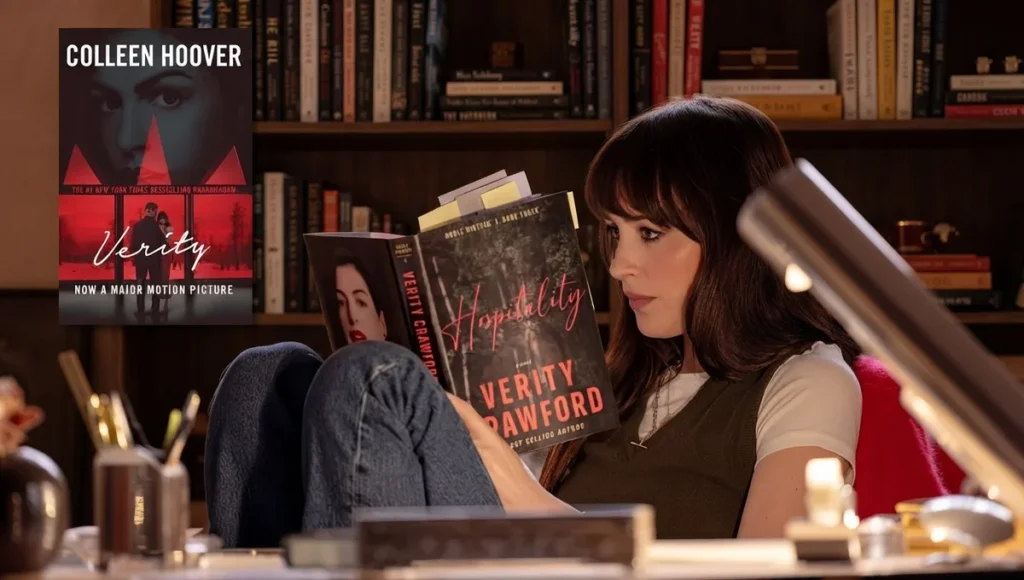
Johnson plays Lowen Ashleigh, a struggling novelist who gets hired to help finish the work of bestselling author Verity Crawford, played by Hathaway.
Verity has been left unable to continue writing after a serious accident. Her husband Jeremy, played by Hartnett, brings Lowen into their secluded home to go through Verity’s unfinished work.
Then Lowen finds something she was never supposed to see.
It’s an autobiographical manuscript that appears to expose Verity’s darkest thoughts and actions.
But there is a catch.
Lowen doesn’t know whether she’s reading the truth or another piece of fiction.
That uncertainty is what makes the premise work. You’re not simply waiting to find out what happened. You’re constantly asking yourself which version of the story deserves to be believed.
The problem is that the movie doesn’t always trust that question enough.
The Strange Thing About Verity’s Tone
This is where I think the critical divide becomes easier to understand.
Verity is dark, sexy, disturbing and occasionally ridiculous. Those qualities aren’t necessarily a problem. In fact, they could have made the movie a lot of fun.
The trouble starts when the film moves between those moods without always making the transition feel intentional.
One critic praised it as “unbelievably, deliciously campy.” Another argued that director Michael Showalter doesn’t have enough feel for the erotic-thriller genre. Collider, meanwhile, criticized the film for playing things too safely.
Those reviews sound contradictory, but they are actually pointing at the same issue.
The movie is at its most interesting when it embraces how strange its own story is.
When it becomes too serious, some of the twists lose their bite. When it allows itself to be excessive, suddenly the whole thing becomes more entertaining.
That’s a difficult balance to pull off.
Anne Hathaway Understands the Movie Better Than Anyone
Hathaway is probably the easiest part of Verity to talk about without getting lost in the larger debate.
Even critics who dislike the movie have found something to appreciate in her performance. Collider praised the way she approaches the complicated character, while Slashfilm described her as the film’s “saving grace.”
What works is that Hathaway doesn’t seem afraid of the material.
She plays Verity with a theatrical edge, and that makes sense because Verity herself is supposed to feel larger than the room she’s in.
There is something slightly unsettling about watching a character who can dominate the story without actually being able to control what is happening around her.
That gives Hathaway some of the movie’s strongest scenes.
The interesting part is that the performance doesn’t necessarily make the film more serious. If anything, it makes the movie’s stranger side more enjoyable.
Dakota Johnson Has the Harder Job
Lowen is a much more difficult character to play.
She has to be the audience’s guide while simultaneously making questionable decisions, falling deeper into the Crawford family’s secrets and trying to decide whether the manuscript is real.
That means Johnson has to carry much of the movie’s emotional uncertainty.
And this is where critics disagree again.
Deadline found her performance watchable, while Variety was far less impressed and criticized her delivery.
I think the split makes sense.
Lowen is deliberately written as someone who doesn’t have all the answers. That can create an interesting detached quality, but it can also make the character feel emotionally distant.
If you connect with Lowen, the mystery becomes personal.
If you don’t, you’re mostly waiting for the next twist.
The House Does a Lot of Heavy Lifting
There is one thing Verity gets right almost immediately: the setting looks like trouble.
The Crawford home is isolated, expensive and just unsettling enough to make every quiet hallway feel suspicious.
The film also uses gothic visual touches to create the right atmosphere, including a split-diopter shot noted by AV Club.
But a beautiful creepy house can’t create suspense on its own.
The story still needs to make us care about the people inside it.
That’s why the movie’s visual polish can sometimes feel stronger than its emotional tension. It looks like a thriller before it always feels like one.
Is Verity Actually Scary?
I wouldn’t call Verity a straight horror movie.
Its real discomfort comes from the characters.
Who is lying?
Who is manipulating whom?
And what happens when Lowen starts believing something that may not be true?
There are jump-scares, but the movie’s central appeal is psychological rather than supernatural.
For me, the mystery works best when the film leaves room for doubt.
Once a thriller starts pointing at its own mystery too aggressively, the audience can begin to feel one step ahead of it.
That appears to be one of the complaints behind the mixed reviews: some critics felt the film explains or highlights its ambiguities instead of simply letting them sit there and bother you.
And a mystery is usually more effective when it makes you uncomfortable without telling you exactly why.
The Ending Could Change Your Entire Reaction
The ending is another major point of debate.
The reported production history says the filmmakers changed it after focus-group screenings, and criticism of the final act appears repeatedly in the early reviews.
I won’t spoil what happens.
But this is probably one of those movies where knowing the ending beforehand could completely change your opinion of the entire story.
For people who have read Hoover’s novel, there is another layer to the conversation because the adaptation invites an immediate comparison between the two versions.
That makes the ending particularly important for the book’s existing fan base.
Why the Mixed Reviews May Actually Help Verity
Here’s the part I find most interesting.
A completely forgettable thriller usually doesn’t create this much disagreement.
With Verity, critics aren’t simply saying the same thing in different ways. They’re reacting to the movie’s personality.
One person sees camp.
Another sees bad taste.
One sees Hathaway’s performance as exactly what the movie needs.
Another thinks the same theatrical quality exposes the film’s weaknesses.
That doesn’t mean every criticism is equally convincing. It simply means Verity is giving viewers enough material to argue about.
And for a movie built around unreliable perspectives, there is something almost fitting about that.
What About the Box Office?
The critical response hasn’t stopped interest in the movie.
Early projections had Verity heading toward a No. 1 opening of around $32 million.
That matters because Hoover’s audience doesn’t necessarily behave like a traditional prestige-movie audience.
People who loved the book may want to see how its most controversial moments were handled regardless of what critics think.
So the movie now has two separate conversations happening at once: Does Verity work as a film? And does it work as a Colleen Hoover adaptation?
Those aren’t necessarily the same question.
So, Is Verity Worth Watching?
If you want a perfectly controlled psychological thriller, I’d keep expectations in check.
But if you enjoy movies that are messy, glossy, provocative and occasionally a little ridiculous, Verity has enough personality to make the experience worthwhile.
And that is probably the key to enjoying it.
Don’t go in expecting a completely serious mystery.
The movie seems to work better when you accept that some of its excess is part of the experience.
For Hoover fans, the appeal is obvious. For everyone else, the question is whether the combination of Hathaway, Johnson, Hartnett and a deliberately uncomfortable story is enough to keep you watching.
For me, it probably is — but more because I want to see where this strange story goes than because the movie has mastered every part of the thriller formula.
Final Verdict
Verity isn’t a clean, perfectly balanced thriller.
It is stranger than that.
Sometimes it feels like a psychological mystery. Sometimes an erotic thriller. And sometimes it gets close to becoming a glossy piece of camp before pulling itself back.
But that inconsistency is also what makes the movie worth talking about.
Anne Hathaway brings the biggest spark, the central mystery remains compelling enough to keep the story moving, and the movie has clearly found an audience even while critics remain divided.
The biggest missed opportunity is that Verity could have gone even further.
Instead of worrying about whether the story looks too outrageous, the movie should have trusted its own weirdness.
Verdict: Verity is a stylish, messy and divisive thriller. It won’t satisfy everyone looking for a tightly constructed mystery, but viewers willing to embrace its darker and campier side may find considerably more fun in it.
FAQ
Is Verity based on a Colleen Hoover book?
Yes. The film adapts Hoover’s 2018 psychological thriller Verity.
Who stars in Verity?
Anne Hathaway, Dakota Johnson and Josh Hartnett lead the movie.
Is Verity a horror movie?
It’s primarily a psychological and erotic thriller, although it includes some horror-style moments and jump-scares.
Is Verity worth watching?
If you enjoy twist-heavy thrillers with a campy edge, it may be worth seeing. Viewers looking for a tightly controlled psychological mystery may have a different reaction.

Faizullah Baig
Entertainment & Digital Culture Writer at WordPlay2018
Faizullah Baig is a writer at WordPlay2018 covering entertainment, celebrity news, movies, television, pop culture, and digital trends.
His work focuses on explaining current entertainment stories in a clear and reader-friendly way, with attention to the details behind trending headlines.
Areas of Coverage
Faizullah primarily covers:
Celebrity news and profiles
Movies and television
Entertainment industry developments
Celebrity relationships and public appearances
Trending pop-culture stories
Digital culture and online trends
Editorial Approach
Faizullah aims to distinguish confirmed information from reports, estimates, and speculation. For developing stories, information may be updated as additional reliable details become available.
Articles published under his name are intended to provide readers with useful context rather than simply repeat a headline or social-media claim.
Contact
For corrections, questions, or feedback about an article published under Faizullah Baig’s name, please contact:
Publication: WordPlay2018
Role: Entertainment & Digital Culture Writer