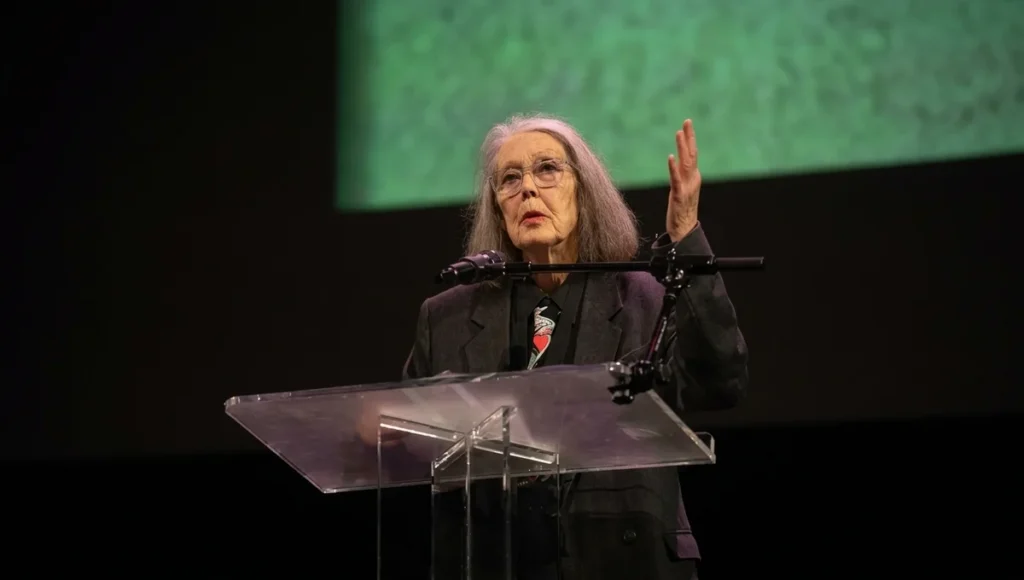
Anne Carson has won the 2026 Nobel Prize in Literature, putting one of Canada’s most unconventional literary voices at the center of global attention. The Swedish Academy announced the award on October 8, 2026, praising Carson for creating new forms of contemporary literature through an inventive conversation with classical tradition.
The decision is significant because Carson has never fit comfortably into one literary category. She is a poet, essayist, translator and classical scholar whose books can move between poetry, prose, drama, scholarship and visual forms without treating those boundaries as fixed.
Anne Carson Nobel Prize at a Glance
| Detail | What to Know |
|---|---|
| Winner | Anne Carson |
| Award | 2026 Nobel Prize in Literature |
| Announced | October 8, 2026 |
| Born | 1950, Toronto, Canada |
| Known for | Poetry, essays, translations and classical scholarship |
| Famous work | Autobiography of Red |
| Nobel citation | “for her bold and inventive oeuvre…” |
| Prize amount | 12 million Swedish kronor |
Why Anne Carson Won the Nobel Prize
The Swedish Academy’s official citation offers a useful explanation for why Carson’s work stands apart.
The Academy honored her “bold and inventive oeuvre” for its “playful dialogue with the classical tradition” and its creation of new forms for contemporary literature.
That description captures the central idea behind Carson’s writing. She does not simply revisit ancient literature as a scholar. She takes old stories, characters, languages and ideas and places them into forms that can feel strikingly modern.
Ancient Greek literature is particularly important to her work, but Carson’s books are rarely straightforward retellings. Her approach can involve verse, fiction, translation, fragments, dialogue and visual material, often within the same larger project.
That combination has made her difficult to categorize — and that may be exactly what makes the Nobel recognition so fitting.
The Book That Introduced Many Readers to Carson
For many readers, the obvious starting point is Autobiography of Red, her 1998 verse novel.
The book takes the ancient Greek figure Geryon and turns him into the center of a contemporary coming-of-age story. Carson uses the mythological framework as a starting point rather than a limitation, allowing the ancient character to experience love, identity and vulnerability in a very different world.
The book helped establish the qualities that would define Carson’s reputation: intellectual ambition without conventional academic distance, unusual structures and a willingness to let poetry behave like fiction.
Her later work Red Doc> returned to the characters and ideas from Autobiography of Red. The book won the Canadian category of the 2014 Griffin Poetry Prize, reinforcing Carson’s standing as one of contemporary poetry’s most distinctive writers.
Carson’s Work Goes Far Beyond Poetry
Calling Carson simply a poet misses much of what makes her career unusual.
Her bibliography includes poetry collections, essays, translations, plays and opera-related work. She has also translated classical Greek writers and repeatedly used ancient literature as a way to examine modern experiences.
Books such as Eros the Bittersweet, Men in the Off Hours, The Beauty of the Husband and Nox show how widely she has experimented with form and subject. Nox, published in 2010, was created as an accordion-fold book combining photographs, letters and other material around a translation of Catullus.
Her 2019 performance work Norma Jeane Baker of Troy provides another example. Carson placed Marilyn Monroe alongside Helen of Troy, connecting a modern cultural icon with one of the most recognizable women from classical mythology.
This habit of making unexpected connections is central to understanding her work. Carson treats the past less like a museum piece and more like material that can still be rearranged.
From Classical Scholar to Nobel Laureate
Carson’s academic background is just as important as her literary career.
She was born in Toronto in 1950 and developed an early interest in Greek and Latin literature. She later became a professor of Classics, building an academic career alongside her writing and translation work.
That background helps explain the unusual balance in her books. Carson approaches words with the precision of a scholar but often uses them with the freedom of a poet.
The Griffin Poetry Prize has described her work as combining poetry, verse essays, classical scholarship and meditations on artists and history. Carson has also received major honors including a MacArthur Fellowship in 2000, the T.S. Eliot Prize and the Princess of Asturias Award for Literature in 2020.
The Nobel therefore adds the highest-profile literary recognition to a career that had already attracted substantial critical and institutional attention.
What Makes Carson Different From a Conventional Nobel Winner?
The interesting part of Carson’s victory is not simply that a Canadian writer has won.
It is that the Academy has rewarded a writer whose greatest strength may be her refusal to stay inside traditional literary borders.
Carson can write about an ancient Greek myth, turn it into a modern story, interrupt the narrative with scholarship and then shift the reader’s attention toward a completely different voice or form. Her books often ask readers to participate rather than simply consume a conventional plot.
That can make her work challenging. It can also make it unusually rewarding for readers who enjoy literature that refuses easy definitions.
The Nobel citation effectively recognizes that quality. Rather than honoring Carson for fitting an established model of literary greatness, the Academy has highlighted the way she has expanded what contemporary literature can look like.
Anne Carson’s Nobel Win Comes at an Interesting Moment
The award also arrives at a time when literary institutions are increasingly looking beyond traditional genre boundaries.
Carson’s career sits at the intersection of poetry, translation, classical studies, theater and visual art. Her work has influenced and collaborated with artists working outside conventional publishing, helping give her writing a life beyond the page.
That makes her Nobel particularly relevant to readers who may not normally follow poetry.
The wider entertainment-news cycle has also continued to produce major stories about well-known public figures, such as another recent celebrity news story, showing how quickly public attention can shift across different areas of culture.
The prize could introduce a much wider audience to books that have long circulated among poetry readers, academics and literary enthusiasts. It may also encourage new translations and editions of her work around the world.
What Happens After the Nobel?
Carson’s Nobel comes with 12 million Swedish kronor, but the larger impact may be cultural rather than financial.
A Nobel win almost always changes the scale of attention around a writer. Books are rediscovered, older titles return to bookstores and readers who have never encountered the author begin searching for an entry point.
For Carson, Autobiography of Red is likely to remain the obvious starting place. But her broader bibliography gives new readers plenty of directions to explore, from classical translation to experimental poetry and hybrid forms.
The prize may ultimately make Carson more accessible without making her work any less challenging.
What Is Confirmed About Anne Carson’s Nobel?
- Confirmed: Carson won the 2026 Nobel Prize in Literature on October 8, 2026.
- Confirmed: The Swedish Academy cited her bold and inventive body of work and its dialogue with classical tradition.
- Confirmed: The prize is worth 12 million Swedish kronor.
- Confirmed: Carson was born in Toronto in 1950 and has built a career across poetry, essays, translation and classical scholarship.
There is no need to invent a dramatic explanation for the decision. The Academy’s citation already makes the reasoning clear: Carson’s work has expanded the possibilities of contemporary literature by bringing the ancient and modern into an unusually flexible conversation.
Final Take
Anne Carson’s 2026 Nobel Prize in Literature feels like recognition of an entire way of writing rather than a single famous book.
Her achievement lies in making ancient literature feel unsettled and contemporary while refusing to separate poetry from scholarship, fiction from criticism or the written word from other forms of art.
That is why Carson’s Nobel win matters beyond the literary world. It is a reminder that some of the most influential writers are not the easiest to classify.
And in Carson’s case, that refusal to fit neatly into a category may be precisely what the Nobel Prize is celebrating.
FAQ
Who won the 2026 Nobel Prize in Literature?
Canadian poet, essayist and classical scholar Anne Carson won the 2026 Nobel Prize in Literature.
Why did Anne Carson win the Nobel Prize?
The Swedish Academy honored her bold and inventive body of work and its playful engagement with classical tradition.
What is Anne Carson’s most famous book?
Autobiography of Red, a 1998 novel in verse inspired by the ancient Greek figure Geryon, is among her best-known works.
How old is Anne Carson?
Carson was born in 1950 and is 76 years old in 2026.
What is the 2026 Nobel Literature Prize worth?
The prize carries an award of 12 million Swedish kronor.
Sources / Research Notes
- Nobel Prize / Swedish Academy — 2026 Nobel Prize in Literature announcement and official citation.
- Reuters — Anne Carson wins the 2026 Nobel Prize in Literature and background on her work.
- Associated Press — Carson’s career, major books and response to the award.
- The Guardian — Nobel announcement and Carson biography.
- University of Toronto — Carson’s background and connection to the university.
- Griffin Poetry Prize — Carson biography, awards and Red Doc> recognition.
- The Irish Times — Nobel context and Carson’s literary career.

Faizullah Baig
Entertainment & Digital Culture Writer at WordPlay2018
Faizullah Baig is a writer at WordPlay2018 covering entertainment, celebrity news, movies, television, pop culture, and digital trends.
His work focuses on explaining current entertainment stories in a clear and reader-friendly way, with attention to the details behind trending headlines.
Areas of Coverage
Faizullah primarily covers:
Celebrity news and profiles
Movies and television
Entertainment industry developments
Celebrity relationships and public appearances
Trending pop-culture stories
Digital culture and online trends
Editorial Approach
Faizullah aims to distinguish confirmed information from reports, estimates, and speculation. For developing stories, information may be updated as additional reliable details become available.
Articles published under his name are intended to provide readers with useful context rather than simply repeat a headline or social-media claim.
Contact
For corrections, questions, or feedback about an article published under Faizullah Baig’s name, please contact:
Publication: WordPlay2018
Role: Entertainment & Digital Culture Writer