
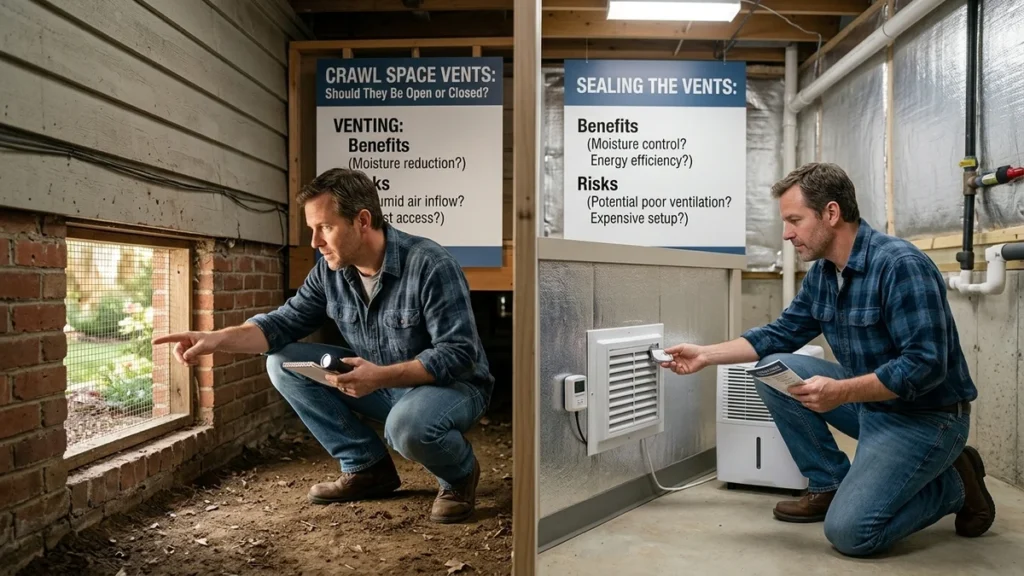
The first time I considered whether to open or close my crawl space vents, I was surprised by how complex the answer turned out to be. In my analysis of this common homeowner question, I have found that the decision isn’t as simple as “open in summer, close in winter” as many old-timers might suggest. From my perspective, understanding crawl space ventilation requires us to look at modern building science, climate considerations, and the condition of your specific crawl space.
Based on the available evidence, the short answer is that for most modern homes, crawl space vents should be kept closed year-round . However, as with many home maintenance questions, the full picture is more nuanced. Let us consider the factors that determine the right approach for your home: your climate, the condition of your crawl space, whether you have a vapor barrier, and your home’s overall moisture management strategy.
Understanding the Traditional Approach to Crawl Space Vents
For many years, building codes required crawl space vents as a standard practice . This approach was based on the belief that allowing outside air to circulate beneath the house would help control moisture and prevent problems like wood rot and foundation damage . The logic seemed sound: outdoor air moving through the crawl space would carry away moisture and keep the space dry .
The traditional approach required ventilation openings of at least 1 square foot of net free area for every 150 square feet of crawl space floor area. This 1:150 ratio could be reduced to 1:1500 if a vapor barrier covered the ground . Vents were typically placed on all sides of the crawl space to encourage cross-ventilation .
Why the Old Approach Is Being Challenged
Recent building science research has revealed that this traditional approach doesn’t always work as intended. In fact, in many climates, open crawl space vents can actually make moisture problems worse .
When outdoor air is warm and humid, as it often is during summer in the southeastern United States, opening vents allows that moisture-laden air to flow into the crawl space . This warm, moist air then condenses on cooler surfaces like floor joists and foundation walls, creating the perfect environment for mold and wood rot .
One expert explained this phenomenon using a simple analogy: air conditioning can make crawl space moisture worse in hot climates. As This Old House’s Tom Silva noted, “The AC lowers the floor temperature enough in the summer to cause condensation to form the same way water collects on a glass of iced tea. That moisture, trapped under the tar paper in the sauna-like crawl space, gave mold and rot fungi the perfect environment to take hold” .
Should Crawl Space Vents Be Open or Closed? The Modern Consensus
Based on the available evidence, building scientists now generally recommend that crawl space vents be kept closed, with the crawl space sealed and conditioned as part of the home’s overall envelope . This approach is often called “crawl space encapsulation” .
The International Residential Code (IRC) now permits unvented crawl spaces, provided certain conditions are met . This shift reflects decades of research showing that sealed crawl spaces consistently perform better than vented ones in all but the driest climates .
When to Keep Vents Closed Year-Round
Michael Rubino, a mold and air quality expert, advises that “in most cases, keeping crawl space vents closed year-round is best, especially if the crawl space is encapsulated or has a vapor barrier. It helps control moisture levels, stabilize temperatures, and prevent mold or pest infestations” .
You should keep your crawl space vents closed if:
- You live in a hot, humid climate (Climate Zones 1 through 4, including most of the South and mid-Atlantic)
- You have a crawl space encapsulation system with a vapor barrier and dehumidifier
- Your crawl space has a history of moisture problems, mold, or pest infestations
- You want to improve energy efficiency by preventing heat loss in winter and heat gain in summer
When to Consider Opening Vents
In specific situations, opening crawl space vents can be beneficial .
Consider opening vents briefly:
- During dry, mild weather (typically spring or fall) to facilitate air exchange
- For limited periods (a few hours daily on dry days, preferably in early morning or late afternoon)
- In arid or colder climates where outdoor air is naturally dry
However, even in these cases, Rubino advises consulting a professional first to ensure that opening vents won’t create unwanted issues .
Seasonal Vent Management: Traditional vs. Modern Approaches
The Traditional Seasonal Approach
Many homeowners have been advised to open vents in spring and close them in winter . In winter, closing vents helps retain heat and can prevent pipes from freezing . The logic is that cold air sinks, and crawl spaces are often built slightly below ground level, so open vents become pits of chilly air. By closing them, you seal in any warm air that leaks down through your floor or any heat generated by appliances .
In summer, the conventional wisdom says to open vents to allow air circulation and prevent heat buildup . However, as discussed above, this approach can backfire in humid climates .
The Modern Approach: Annual Ventilation Is Outdated
Building science has shown that seasonal vent management is not enough to control crawl space moisture effectively. As one expert noted, simply closing vents without a vapor barrier and controlled exhaust just traps moisture in the crawl space . In hot, humid climates, open vents can actually introduce more moisture than they remove .
This is why the modern building code now permits sealed crawl spaces as an alternative to traditional vented ones .
The Problem with Open Vents: A Closer Look
Open crawl space vents can cause several problems for homeowners:
Moisture Intrusion and Mold Growth
In humid climates, open vents allow warm, moist outdoor air to enter the crawl space . When this air contacts cooler surfaces, condensation forms . Over time, this moisture can lead to:
- Mold and mildew growth
- Wood rot in floor joists, beams, and sill plates
- Structural damage that can be expensive to repair
A study published in ScienceDirect found that outdoor air ventilation in crawl spaces can be problematic in summer when outdoor air is warmer and has higher moisture content than crawl space air. This means outdoor air can transport moisture into the relatively cool crawl space, causing relative humidity to rise .
Pest Infestations
Open vents can provide easy access for rodents, insects, and other pests . Animals seek out shelter from the elements, and crawl spaces can be significantly cooler than outside temperatures in summer .
Increased Energy Costs
Open vents can increase energy costs due to air leakage. In winter, cold air entering the crawl space can cause heat loss through the floor . In summer, hot air entering the crawl space can make air conditioning less efficient . As one expert explained, “Hot air rises, and a sweltering crawl space means your air conditioning has to work extra hard” .
Frozen Pipes in Cold Climates
In colder regions, open vents allow cold air to circulate around pipes, increasing the risk of frozen or burst pipes .
The Solution: Crawl Space Encapsulation
Given the problems with open vents, building scientists now recommend crawl space encapsulation as the most effective solution .
What Is Crawl Space Encapsulation?
Crawl space encapsulation is the process of sealing the crawl space from the outside environment and treating it as part of the conditioned living space . This involves:
Sealing all vents and air leaks: Foundation vents are permanently sealed, not just closed .
Installing a vapor barrier: Heavy-duty polyethylene sheeting (12-20 mil thick, 3-6 times thicker than standard vapor barrier) covers the entire floor and extends up the walls at least 6 inches . Seams are lapped 6-12 inches and sealed .
Insulating the walls: Insulation is installed on the foundation walls rather than between floor joists .
Controlling humidity: A dehumidifier is installed to maintain relative humidity below 60% .
Why Encapsulation Works Better
Encapsulation addresses the root problem: moisture comes from the ground and from humid outdoor air. Rather than trying to ventilate this moisture away, encapsulation prevents it from entering in the first place .
A case study from Groundworks in Charleston, SC, shows the effectiveness of this approach. Homeowners who noticed cupping floors discovered high humidity and open vents in their crawl space . After encapsulation—including sealing vents, installing a vapor barrier, insulating walls, and adding a dehumidifier—the crawl space was transformed. The homeowners reported improved air quality and a healthier home .
A ScienceDirect study also supports this approach, finding that outdoor air-ventilated crawl spaces demonstrated “very high performance” when a ground cover was applied . The researchers found that ground covers reduced moisture evaporation and decreased relative humidity significantly .
The Cost of Encapsulation
Crawl space encapsulation is more expensive than simply opening or closing vents, but many experts consider it the best long-term solution . The cost is justified by:
- Preventing costly structural repairs
- Improving energy efficiency
- Enhancing indoor air quality
- Increasing home value
Important Considerations for Encapsulation
If you’re considering encapsulation, there are several important requirements to follow:
- Vapor barrier: The entire floor must be covered with a Class I vapor retarder. Six-mil polyethylene is the minimum, but reinforced 10-12 mil material is better for long-term performance .
- Wall covering: In an unvented crawl space, walls must also be covered with the vapor retarder system .
- Sealing: Foundation vents must be permanently sealed, not just closed .
- Humidity control: Mechanical ventilation or a dehumidifier is required .
- Radon: In radon-prone areas, a sealed crawl space may require a sub-membrane depressurization system .
Climate Considerations
| Climate Zone | Recommended Approach | Key Considerations |
|---|---|---|
| Zones 1-4 (Hot-Humid) | Sealed/Encapsulated | Vented crawl spaces can make moisture problems worse |
| Zones 5-7 (Cold/Dry) | Sealed preferred | Vented can work if well-drained, but sealed has performance advantages |
| Zone 8 (Extreme Cold) | Sealed strongly preferred | Perimeter wall insulation is important |
Common Mistakes Homeowners Make with Crawl Space Vents
Based on my analysis of expert advice and homeowner experiences, several common mistakes can lead to problems:
Sealing Vents Without a Vapor Barrier
One of the most common errors is sealing foundation vents without installing a vapor barrier and exhaust fan . Homeowners who read about the benefits of sealed crawl spaces sometimes close their foundation vents and assume this is sufficient. Without a continuous vapor barrier and controlled exhaust, sealing the vents simply traps moisture in the crawl space, accelerating the mold and rot problems the homeowner was trying to prevent .
Closing Vents in Winter Without Proper Insulation
Another common mistake is closing vents in winter to “keep pipes from freezing.” This eliminates winter ventilation that reduces condensation when outdoor air is cold and dry . The correct approach in cold climates is to insulate pipes and allow ventilation to continue, or to convert to an unvented conditioned crawl space .
Leaving Vents Open Year-Round
Constantly open vents can lead to uncontrolled moisture levels, mold, and structural damage, especially in humid or rainy regions . Even in dry climates, year-round open vents can allow pests to enter and cause energy loss .
Using Undersized Exhaust Fans
In sealed crawl spaces, installing an undersized exhaust fan is a common mistake. A fan rated at 10 CFM in a 1,500-square-foot crawl space moves far too little air to maintain acceptable humidity levels in a humid climate . Experts recommend sizing the fan conservatively, erring toward the larger end of the recommended range .
Failing to Maintain the Vapor Barrier
Tears or gaps in the vapor barrier allow soil moisture to bypass the barrier entirely . Experts recommend inspecting and repairing the vapor barrier annually, particularly after any plumbing or pest control work .
Vapor Barriers: A Critical Element Regardless of Your Ventilation Strategy
Whether you choose to keep your crawl space vents open or closed, installing a vapor barrier is crucial for controlling moisture . A properly installed vapor barrier significantly reduces moisture intrusion from the ground .
Vapor Barrier Installation Requirements
- Material: ≥ 6-mil polyethylene sheeting
- Seam lapping: 6 to 12 inches with sealed seams
- Wall coverage: Lap up walls and piers to at least 6 inches
- Sealing: Seal around all pipes and obstructions
Comparison of Crawl Space Ventilation Approaches
| Feature | Vented Crawl Space (Traditional) | Sealed/Encapsulated Crawl Space (Modern) |
|---|---|---|
| Vent Status | Open, with seasonal adjustments | Permanently sealed |
| Vapor Barrier | Optional (may reduce vent requirements) | Required and continuous |
| Insulation Location | Usually between floor joists | On foundation walls |
| Dehumidifier | Not typically needed | Required for optimal performance |
| Energy Efficiency | Moderate | Higher |
| Moisture Control | Variable by climate | Consistent year-round |
| Pest Risk | Higher (open access points) | Lower |
| Best Climate | Dry climates | All climates, especially hot-humid |
Conclusion
Throughout this exploration of crawl space vents, I have found that the question of whether to keep them open or closed is more nuanced than many homeowners realize. The practical lesson is that while the traditional approach of opening vents in summer and closing them in winter may have been adequate in the past, modern building science has shown that it often fails to control moisture effectively.
I believe the central insight is that crawl space ventilation should be determined by your climate, the condition of your crawl space, and your overall moisture management strategy. For most homes in humid or cold climates, sealing crawl space vents and encapsulating the space is the most effective long-term solution .
From my perspective, the shift from vented to sealed crawl spaces is one of the most important developments in home building in recent decades. It reflects a deeper understanding of how moisture behaves and how to prevent the mold, rot, and structural damage that can result from improper ventilation.
For those interested in maintaining a healthy home, it is also important to understand potential hazards in older building materials. Read our guide to asbestos risks in older homes for more information about identifying potential concerns and seeking professional help.
Frequently Asked Questions
Should crawl space vents be open or closed in summer?
In most cases, especially in humid climates, crawl space vents should be closed in summer. Open vents allow warm, moist outdoor air to enter the crawl space, which can condense on cooler surfaces and lead to mold and rot . If you live in a dry climate, brief ventilation on dry days may be acceptable, but it’s best to consult a professional .
Should crawl space vents be open or closed in winter?
In cold climates, crawl space vents should generally be closed in winter to prevent pipes from freezing and to retain heat in the home . However, simply closing vents without proper insulation and vapor barriers can trap moisture. The best solution is a fully encapsulated crawl space .
What is crawl space encapsulation?
Crawl space encapsulation is the process of sealing the crawl space from the outside environment by sealing all vents, installing a vapor barrier on the floor and walls, insulating the walls, and controlling humidity with a dehumidifier . This approach prevents moisture intrusion and creates a healthier, more energy-efficient home.
Do I need a vapor barrier in my crawl space?
Yes, a vapor barrier is essential in a crawl space to prevent moisture from seeping through the soil. Even in vented crawl spaces, a properly installed vapor barrier significantly reduces moisture issues . The IRC allows a reduced ventilation ratio (1:1500 instead of 1:150) if a vapor barrier covers the ground .
How do I know if my crawl space has a moisture problem?
Signs of crawl space moisture problems include musty odors, mold growth, cupping or buckling floors, high humidity levels (above 60%), and visible condensation on pipes or floor joists . If you notice any of these signs, you should investigate and address the issue promptly.
What are the building codes for crawl space ventilation?
The International Residential Code (IRC) requires either vented crawl spaces with openings (1:150 or 1:1500 ratio) or unvented crawl spaces with proper sealing, vapor barriers, and insulation . Many states have adopted specific provisions that go beyond the IRC baseline, particularly for sealed crawl spaces .
Sources
- “Should Crawl Space Vents Be Opened or Closed?” Angie’s List, August 2023
- “Moisture conditions of outdoor air-ventilated crawl spaces in apartment buildings in a cold climate,” ScienceDirect, 2000
- “IRC 2024 Sealed Crawl Space Exhaust: R408.2 Mechanical Ventilation Requirements,” Jaspector, April 2026
- “Case Study: Moisture Management with Crawl Space Encapsulation in Charleston, SC,” Groundworks, July 2025
- “Should Crawl Space Vents Stay Open or Closed?” This Old House, July 2024
- “The Word: Crawlspace Ventilation,” American Society of Home Inspectors, 2019
- “IRC 2024 Crawl Space Ventilation Requirements (R408.1): 1:150 Ratio and Sealed Options,” Jaspector, April 2026
- “Crawlspace: Capillary Break at Crawlspace Floors,” Building Science Education (U.S. Government)
- “Should you keep crawl space vents open or closed?” Homes and Gardens, November 2024
- “3.1 Recommended Design and Construction Details,” ORNL.gov
- “Tiny crawl space ventilation,” GreenBuildingAdvisor, March 2026
- “Crawl Space Encapsulation and Vapor Barriers for Damp Crawl Spaces,” U.S. Waterproofing, August 2026
Disclaimer
This article provides general information about crawl space ventilation and moisture management for informational and educational purposes. The analysis is based on available public information and may not reflect the most current building codes or practices in your area. This article does not constitute professional home inspection, building, or contracting advice. Homeowners should consult with qualified professionals and check local building codes before making changes to their crawl space ventilation or moisture management systems. The views expressed are those of the author based on available evidence.

Faizullah Baig
Entertainment & Digital Culture Writer at WordPlay2018
Faizullah Baig is a writer at WordPlay2018 covering entertainment, celebrity news, movies, television, pop culture, and digital trends.
His work focuses on explaining current entertainment stories in a clear and reader-friendly way, with attention to the details behind trending headlines.
Areas of Coverage
Faizullah primarily covers:
Celebrity news and profiles
Movies and television
Entertainment industry developments
Celebrity relationships and public appearances
Trending pop-culture stories
Digital culture and online trends
Editorial Approach
Faizullah aims to distinguish confirmed information from reports, estimates, and speculation. For developing stories, information may be updated as additional reliable details become available.
Articles published under his name are intended to provide readers with useful context rather than simply repeat a headline or social-media claim.
Contact
For corrections, questions, or feedback about an article published under Faizullah Baig’s name, please contact:
Publication: WordPlay2018
Role: Entertainment & Digital Culture Writer