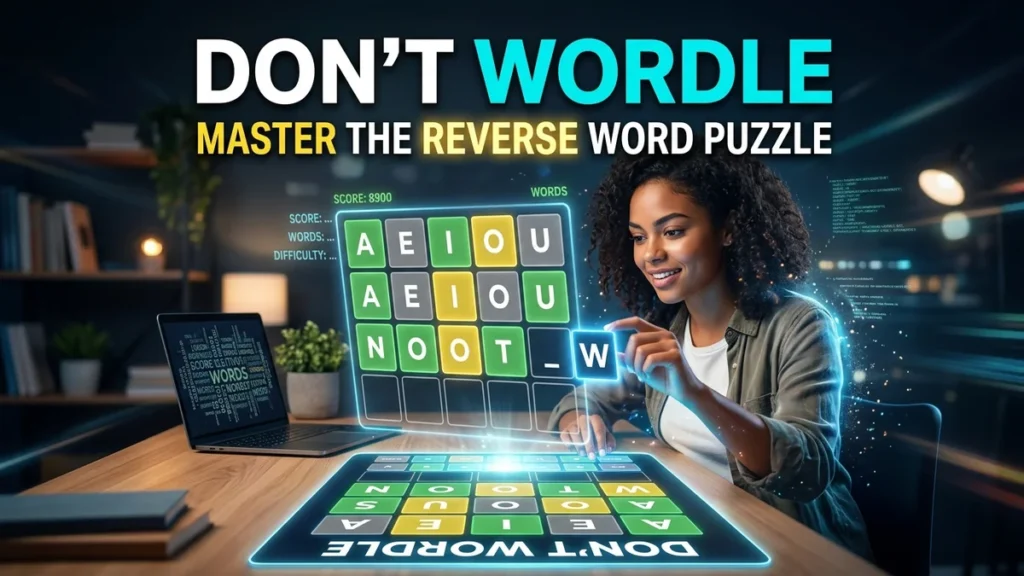
I believe that dont wordle represents one of the most clever and counterintuitive twists on a familiar formula that I have encountered in the world of daily puzzle games. In my analysis, the game takes everything players learned from Wordle and inverts it, transforming the instinct to solve into the primary threat. From my perspective, this reversal creates a tension that is both intellectually fascinating and genuinely challenging to navigate.
We can see this tension play out in every guess a player makes. Dont wordle asks you to follow the same color-coded feedback system that Wordle uses, but your goal is to avoid typing the hidden answer for six full rows. The moment you type the correct word, you lose. The game rewards hesitation, punishes certainty, and forces players to think about strategy in ways that feel completely alien to anyone who has spent years trying to solve Wordle puzzles as quickly as possible.
In this guide, we will examine what dont wordle is, how it works, why it was created, the two dominant play styles that have emerged within its community, and the practical strategies that give players the best chance of surviving all six guesses. Whether you are a seasoned Wordle veteran looking for a new challenge or a curious newcomer drawn to the game’s unusual premise, I believe this article will give you the tools you need to understand and enjoy this remarkable puzzle. For more engaging content on games and word puzzles, you can also visit Wordplay 2018.
Key Takeaways for Understanding Dont Wordle
Before we examine the details, I want to summarize the most important principles that will guide our discussion. First, dont wordle is a reverse Wordle puzzle where players must avoid guessing the hidden five-letter word for six consecutive guesses. Second, the game uses identical color-coded feedback to standard Wordle: green means correct letter in the correct position, yellow means correct letter in the wrong position, and gray means the letter is absent. Third, the game enforces hard-mode constraints, meaning players must reuse green letters in their correct positions and yellow letters in different positions. Fourth, a live counter displays the number of valid words remaining, dropping with each guess. Fifth, players have a limited number of undos to escape dangerous situations. Sixth, two distinct play styles have emerged: the Purist approach and the Strategist approach. Finally, understanding the inverted incentive structure is the key to developing an effective strategy.
What Is Dont Wordle and How Does It Work?
Dont wordle is a free browser-based daily word puzzle that reverses the fundamental objective of Wordle. According to the game’s own description, it “flips the Wordle formula: every clue helps you identify the hidden five-letter answer, but your goal is to avoid typing it”. The game runs natively in the browser with undo support, local progress saving, and a legal-word counter.
Let us consider how this works in practice. When you open the game, you see a standard 6×5 grid and a counter at the top showing the number of valid words remaining, which starts at approximately 12,974. You have six guesses, just like in Wordle. After each guess, the tiles light up with the familiar green, yellow, and gray feedback. The difference is that the game enforces hard-mode rules. Green letters must stay in the same position in all future guesses. Yellow letters must be used somewhere else in future guesses. Gray letters are forbidden entirely.
From my perspective, this design creates an experience that feels familiar on the surface but operates on a completely different psychological level. In standard Wordle, each clue brings you closer to victory. In dont wordle, each clue brings you closer to a trap. The more information you accumulate, the narrower your remaining options become, and the more likely you are to accidentally type the answer.
The game’s creator explained the origin of this concept in a Hacker News post, stating that the idea emerged after his Wordle win streak reached 99 games. “I was admittedly very careful with my guesses on Day 100, not wanting to ruin my streak,” he wrote. “Then I began to wonder…even if I wanted to lose intentionally, could I do it?”. This question led to the creation of dont wordle, a game that transforms the instinct to solve into the primary source of danger.
How Dont Wordle Flips the Wordle Formula
I have found that understanding the exact ways in which dont wordle inverts Wordle’s mechanics is essential for developing a viable strategy. The following table provides a direct comparison between the two games, highlighting the key differences that define the reverse puzzle experience.
| Aspect | Standard Wordle | Dont Wordle |
|---|---|---|
| Primary Objective | Guess the hidden word within six tries | Avoid guessing the hidden word for six tries |
| Winning Condition | Type the correct word | Survive six guesses without typing the correct word |
| Losing Condition | Fail to guess the word in six tries | Type the hidden word at any point |
| Green Letters | Confirmation of progress | Constraint that locks a letter in place |
| Yellow Letters | Information about misplacement | Constraint that forces relocation |
| Gray Letters | Elimination of possibilities | Permanent removal of options |
| Strategic Goal | Maximize information gained | Minimize information gained while staying valid |
| Psychological Effect | Building confidence toward solution | Building tension toward accidental loss |
The most important takeaway from this table is that every mechanic in dont wordle serves the opposite purpose of its equivalent in standard Wordle. Green letters, which normally signal progress, become restrictive constraints that narrow your safe options. Yellow letters, which normally guide you toward the answer, become burdens that force you to use specific letters in specific ways. Gray letters, which normally help you eliminate possibilities, become permanent restrictions that reduce your available vocabulary. In my analysis, this inversion is what makes dont wordle so intellectually engaging. It forces players to unlearn deeply ingrained habits and develop an entirely new approach to word puzzle strategy.
Core Features That Define the Dont Wordle Experience
I believe that several key features distinguish dont wordle from other Wordle variants and contribute to its unique gameplay experience. Let us examine each of these features in detail.
The Valid Words Remaining counter is perhaps the most important strategic tool in the game. This live counter displays how many legal words remain based on the clues you have accumulated. According to the game’s description, it “shows how many valid words remain” and drops with every guess. The creator noted that he added this feature “when I realized how challenging the game was. I kept getting stuck and wondering whether there were even any words left besides the Wordle word”.
From my perspective, this counter is both a blessing and a curse. It provides essential information about the shrinking space of valid guesses, but it can also create a false sense of security. As one analysis noted, “合法词数量再多,也不代表存在能让你活到最后一步的路径” — the number of valid words does not guarantee that a path to survival exists. The counter tells you how many words remain, but it does not tell you whether any sequence of those words can carry you through all six guesses without hitting the answer.
The Undo System and Its Limitations
The undo system provides a safety net for players who find themselves in dangerous situations. Standard mode grants five undos, while hard mode limits players to two. When the valid words counter drops dangerously low, players can spend an undo to reverse their last guess and try a safer alternative.
However, the undo system has a critical limitation. If a player types the actual hidden word, the game ends immediately, regardless of how many undos remain. As one source explains, “If you enter the Wordle word by accident, the game is over, even if you still have some UNDOs”. This rule ensures that the game’s core tension remains intact. Players cannot simply undo their way out of the fundamental danger of typing the answer.
The Hard-Mode Constraint System
Dont wordle enforces hard-mode constraints that make the game significantly more difficult than a casual variant might be. Green letters are locked in place, yellow letters must be relocated, and gray letters cannot be reused. According to the game’s rules, every guess must be a valid English word that respects all previously accumulated constraints.
From my analysis, this constraint system is what transforms dont wordle from a simple reversal into a genuinely challenging strategic puzzle. Without the hard-mode rules, players could simply type random words and ignore the feedback entirely. The constraints force players to engage with the clues, but in an inverted way. Instead of using clues to find the answer, players must use clues to avoid it while still satisfying all the rules the clues impose.
Table 2: Dont Wordle Game Modes and Features Compared
The following table provides a comparison of the key features and game modes available in dont wordle. I have designed this table to help readers understand the options available and the trade-offs associated with each.
| Feature | Standard Mode | Hard Mode |
|---|---|---|
| Guesses Allowed | 6 | 6 |
| Undos Available | 5 | 2 |
| Hard-Mode Constraints | Enforced | Enforced |
| Valid Word Counter | Yes | Yes |
| Progress Saving | Local browser storage | Local browser storage |
| Free to Play | Yes | Yes |
The most important takeaway from this table is that dont wordle offers a consistent core experience across both modes, with the primary difference being the number of undos available. Standard mode provides a more forgiving experience for newcomers, while hard mode strips away most of the safety net and demands more careful planning from the first guess. In my view, players should start with standard mode to learn the game’s rhythms before attempting hard mode.
The Origin Story: How a 99-Game Streak Inspired a Reverse Puzzle
I have found that the origin story of dont wordle adds an important dimension to understanding the game’s design philosophy. The game was created by a developer who had achieved a 99-game win streak in Wordle and began to wonder whether losing intentionally was possible within the rules. As one Spanish-language article explained, “La idea fue desarrollada por un aficionado después de alcanzar una racha de 99 partidas ganadas en Wordle durante 2022” — the idea was developed by a fan after reaching a streak of 99 wins in Wordle during 2022.
The creator elaborated on this origin in his Hacker News post, describing the progression of the game’s development. The first version was simpler, without the valid words counter or undo system. He even displayed the Wordle answer at the top of the screen throughout the game. However, he later decided that showing the answer “violated the spirit of the game” and replaced it with the valid words counter and undo system.
From my perspective, this iterative design process reflects a thoughtful approach to game development. The creator did not simply invert Wordle’s rules and call it a day. He tested the concept, identified problems, and refined the mechanics to create a more balanced and engaging experience. The addition of the valid words counter and undo system transformed the game from a frustrating exercise in avoidance into a strategic puzzle with meaningful decisions at every turn.
“I am the creator of Don’t Wordle. Really excited to see this took off today. I thought I would share some background about the game, some of the iterations I went through, and some of the future features I would like to add.”
— Creator of Dont Wordle, in a Hacker News post (Hacker News, 2022)
This quotation from the creator provides valuable insight into the game’s development philosophy. The creator’s willingness to share his design process and engage with the community reflects a collaborative approach that has contributed to the game’s success. In my view, this transparency has helped build a community around the game that is invested in its continued development and improvement.
Two Play Styles: Purist vs. Strategist
I believe that one of the most fascinating aspects of the dont wordle community is the emergence of two distinct play styles, each with its own philosophy about how the game should be approached. Understanding these styles helps players identify their own preferences and develop a strategy that aligns with their values.
The Purist approach is defined by a commitment to the game’s spirit of honest avoidance. Purists start with a random or common word, refuse to use the undo function, and limit themselves to common vocabulary. According to one analysis, “官方定义的’Purist’纯粹派,规则很朴素:随机起始词,不用任何撤销,全程只用常见词——最贴近’诚实尝试却输掉’的游戏精神” — the official definition of the Purist approach is simple: random starting words, no undos, and only common words throughout, most closely approximating the spirit of “honestly trying to lose”.
The Strategist approach takes a more pragmatic view. Strategists deliberately choose uncommon or repeated-letter words as their opening guesses, aiming to consume as few common letters as possible and preserve more options for later rounds. This approach treats the game as an optimization problem where the goal is to maximize the number of safe continuations while satisfying all constraints. As one source notes, “Start with words containing uncommon or repeated letters. They’re less likely to hit the answer and preserve more common letters for later rounds when the field narrows”.
From my perspective, the debate between Purists and Strategists reflects a broader tension in game design between intended experience and emergent optimization. Purists argue that the game should be played in the spirit of honest avoidance, relying on mental judgment rather than exploiting rule loopholes. Strategists argue that legal moves are legal, and the game’s own rules define what constitutes valid play. There is no objectively correct answer to this debate, but understanding both perspectives helps players make informed choices about their own approach.
Step-by-Step: How to Play Dont Wordle
Let us walk through a practical process for playing dont wordle, from opening move to final guess. I have organized this as a sequential guide that you can apply to your own gameplay.
Step 1: Choose Your Opening Word
Begin with a word that contains uncommon or repeated letters. According to strategy guides, “Start with words containing uncommon or repeated letters. They’re less likely to hit the answer and preserve more common letters for later rounds when the field narrows”. Words like TIZZY, OXBOW, GRUFF, or MAMMA consume letters that are less likely to appear in the hidden word, preserving your more common letters for later guesses when the field has narrowed.
Step 2: Analyze the Feedback Carefully
After your first guess, examine the color-coded feedback. Note which letters are green, yellow, or gray. Remember that green letters are now locked in their positions and must appear in every future guess. Yellow letters must be relocated. Gray letters are permanently forbidden.
Step 3: Monitor the Valid Words Counter
Watch the counter at the top of the screen carefully. As one strategy guide advises, “Watch the ‘Valid Words Remaining’ number like a hawk — if it drops under 50, seriously consider an undo”. The counter drops rapidly once you start encountering green and yellow letters, because each confirmed letter imposes constraints that eliminate many valid options.
Step 4: Use Undos Strategically
Save your undos for moments when the counter drops dangerously low or when you find yourself trapped with very few options. The creator added the undo system “when I realized the game was still too challenging. It’s particularly lame if you’re playing the game for the first time and you get eliminated after just 1 or 2 guesses”. Do not waste undos on minor inconveniences. Save them for genuine emergencies.
Step 5: Deliberately Avoid the Answer
Once you have mentally deduced the hidden word, do not type it. Instead, choose a different valid word that satisfies all the constraints imposed by the clues. As one source explains, “Once you mentally solve the word, deliberately choose a different valid word that still obeys all green/yellow/gray rules”. This is the game’s ultimate challenge: knowing the answer and choosing not to type it.
Step 6: Survive All Six Guesses
If you reach the sixth guess without typing the answer, you win. The game awards you a “Survived” status and you can share your anti-streak with others. As one player noted, “Hooray! I didn’t Wordle today!”.
Common Mistakes and Misconceptions About Dont Wordle
I have found that several common mistakes and misconceptions undermine players’ success in dont wordle. Let us address the most significant ones.
The first mistake is approaching the game with a Wordle mindset. Players who instinctively try to maximize information gained will find themselves trapped quickly. In dont wordle, the goal is to minimize information gained while still satisfying the constraints of any information you do acquire. This inversion of strategic priorities is difficult to internalize, but it is essential for survival.
The second mistake is trusting the valid words counter too much. As one analysis notes, “合法词数量再多,也不代表存在能让你活到最后一步的路径” — a high valid word count does not guarantee that a path to survival exists. The counter tells you how many words remain, but it does not tell you whether any sequence of those words can carry you through all six guesses. You may be in a doomed position even when the counter shows a seemingly healthy number.
The third mistake is wasting undos on minor situations. Undos are a limited resource, and using them early for small conveniences leaves you vulnerable later when you truly need them. Save your undos for moments when you are genuinely trapped or when the counter drops below 50.
The fourth mistake is assuming that repeated letters behave the same way as in Wordle. The nuances of repeat-letter words create unexpected challenges in dont wordle. The creator himself noted that “the nuances of the repeat letter words” was one of the unexpected challenges he encountered during development. Players should be aware that repeated letters can produce confusing feedback patterns.
The fifth mistake is forgetting that typing the answer ends the game immediately, even with undos available. This rule is absolute. If you type the hidden word, you lose, regardless of how many undos remain. Never type a word you suspect might be the answer, no matter how confident you are.
Expert Recommendations for Surviving Dont Wordle
I recommend that players approach dont wordle with a clear strategic framework and a willingness to adapt their approach based on the unique challenges of each daily puzzle. The following recommendations represent the most effective strategies based on community analysis and practical experience.
Start with uncommon letters. Opening with words that contain rare letters like Z, Q, X, J, and V consumes letters that are unlikely to appear in the hidden word. This preserves your common letters for later guesses and keeps more valid words available in the early rounds.
Use repeated letters strategically. Words with repeated letters consume fewer unique letters, which means you lose fewer options from the valid word pool. A word like MAMMA or COCOA uses only three unique letters, preserving more of your vocabulary for subsequent guesses.
Save your undos for emergencies. The undo system is a limited resource. Use it only when the valid words counter drops dangerously low or when you find yourself in a position with very few remaining options. Do not waste undos on minor inconveniences.
Accept that some puzzles are unwinnable. The creator himself acknowledged that players could find themselves in unwinnable states without realizing it. As one analysis explains, “you could get the game in an unwinnable state without realizing it. For example, maybe 20 valid words remain, but there is no valid sequence of words remaining to finish the puzzle”. If you find yourself in this situation, there is no strategy that can save you. Accept the loss and try again tomorrow.
“The rules not letting use a letter you know isn’t in the target word drastically cuts your choices, your best bet is to use as few unique letters per word as you can, and as uncommon letters as you can, but as all normal words need vowels you’ll be forced into only picking a vowel from the target word soon enough.”
— Community strategy analysis on Hacker News (Hacker News, 2026)
This quotation from a Hacker News discussion captures the essential strategic tension in dont wordle. You want to use as few unique letters as possible, but every English word requires at least one vowel, and you will eventually be forced to use a vowel from the target word. In my view, this constraint is what makes the game so challenging. You cannot avoid engaging with the hidden word’s letters forever. The question is how long you can delay that engagement and how effectively you can manage the constraints once they begin to accumulate.
Conclusion
Dont wordle is a remarkable achievement in game design, transforming the familiar Wordle formula into something that feels entirely new while retaining the accessibility and daily-puzzle appeal that made the original so popular. I believe that the most important finding from this analysis is that the game succeeds because it inverts not just the rules but the psychological experience. Every instinct that helps you win at Wordle becomes a liability in dont wordle, and unlearning those instincts is the first step toward mastering the reverse puzzle.
In my view, the practical lesson for players is to embrace the discomfort of the inverted objective. Start with uncommon letters, monitor the valid words counter, save your undos for genuine emergencies, and accept that some puzzles are unwinnable. The two play styles — Purist and Strategist — offer different paths through the game, and both are valid. My advice is to try both approaches and see which one aligns with your temperament. Whether you play to preserve the spirit of honest avoidance or to optimize your survival through clever letter selection, dont wordle offers a daily challenge that rewards patience, planning, and a willingness to think about word puzzles in an entirely new way. Bookmark the site, play daily, and see how long you can survive without accidentally typing the answer.
Frequently Asked Questions
What Is Dont Wordle and How Does It Work?
Dont wordle is a free browser-based daily word puzzle that reverses the objective of Wordle. Instead of trying to guess a hidden five-letter word within six tries, your goal is to avoid typing that word for six consecutive guesses. The game uses the same green, yellow, and gray feedback system as Wordle, but enforces hard-mode constraints: green letters stay locked, yellow letters must move, and gray letters are forbidden.
Is Dont Wordle Free to Play?
Yes, dont wordle is completely free to play. The game runs natively in your browser and requires no registration, download, or payment. It saves your progress locally and offers a new puzzle every day. The creator built the game using a simple tech stack of Route53, Cloudfront, S3, and Create React App.
How Many Undos Do You Get in Dont Wordle?
Standard mode grants five undos, while hard mode limits players to two. Undos allow you to reverse your last guess and try a safer alternative. However, if you type the actual hidden word, the game ends immediately, regardless of how many undos you have remaining. This rule ensures that the core tension of the game is never fully resolved.
What Is the Best Strategy for Dont Wordle?
The most effective strategy is to start with uncommon or repeated letters to preserve common letters for later rounds. Monitor the valid words counter carefully, use undos only when the counter drops dangerously low, and deliberately avoid typing the answer once you have deduced it. Some players adopt a “Purist” approach with random starting words and no undos, while others adopt a “Strategist” approach with optimized letter selection.
Can You Win Dont Wordle If You’re in an Unwinnable State?
No, if you find yourself in an unwinnable state where no sequence of valid guesses can carry you through all six rows, there is no strategy that can save you. The creator acknowledged this possibility, noting that a high valid word count does not guarantee that a path to survival exists. If you encounter this situation, accept the loss and try again the next day.
Sources and References
- Dont Wordle. “Dont Wordle – A free reverse Wordle puzzle for your browser.” Product Hunt, 2026.
- Dont Wordle. “Follow the clues. Don’t type the answer.” Product Hunt, 2026.
- Dle Games. “Play Don’t Wordle – The Anti-Wordle Daily Puzzle.” DleGames.org, 2026.
- Word Unscrambler. “Don’t Wordle Answers & Hints For Today.” Blog.WordUnscrambler.net, 2026.
- Hacker News. “Show HN: Can you lose at Wordle if you tried?” News.YCombinator.com, 2022.
- IC.work. “赢了99局Wordle之后,他做了个逼你故意输的游戏.” IC.work, 2026.
- 20 Minutos. “¿Eres bueno jugando a Wordle? Esta versión te desafía a perder a propósito para poder ganar.” 20Minutos.es, 2026.
- Hacker News. “Don’t Wordle discussion.” News.YCombinator.com, 2026.
- Playlin. “Don’t Wordle: Play the Daily Word Game.” Playlin.io, 2026.
- Mastodon. “@kibcol1049 on Don’t Wordle.” Mstdn.Social, 2026.
Disclaimer
This article is for informational and educational purposes only. The information provided about dont wordle, its gameplay mechanics, and strategies is based on publicly available sources and community analysis. The author has no affiliation with dont wordle, its creator, or any of the organizations mentioned. The quotations included in this article are attributed to their original sources and are reproduced for commentary and educational purposes. All opinions expressed are the author’s own based on the available evidence. Readers should verify current game features directly with dont wordle before playing.