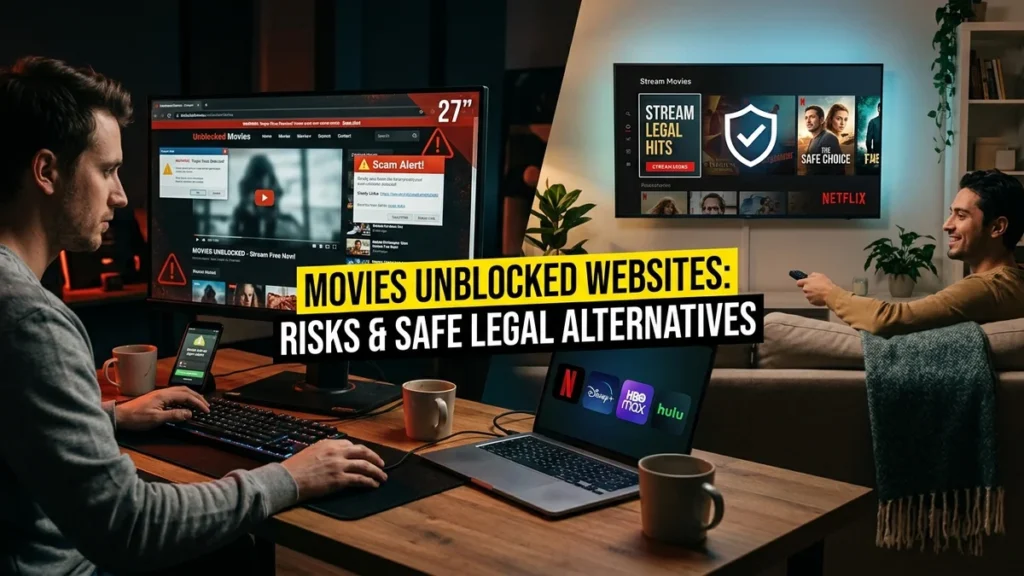
I believe that the search for “movies unblocked websites” reveals something fundamental about the modern entertainment landscape. Millions of people around the world type these words into search engines every month, driven by a simple desire: to watch a film without paying for yet another subscription. In my analysis, the appeal is entirely understandable.
Streaming costs have climbed steadily, content has fragmented across a dozen different platforms, and regional licensing restrictions often block access to films that should be readily available. From my perspective, the frustration that leads people toward unblocked movie sites is real and legitimate.
However, the reality behind these platforms is far more dangerous than most users realize. We can see a troubling disconnect between consumer behavior and consumer awareness. While piracy rates have declined slightly in some regions, the cybersecurity threats associated with unblocked streaming sites have grown more sophisticated and more destructive. This guide will examine what unblocked movie websites actually are, why they persist despite legal pressure, the specific dangers they pose, and the legitimate alternatives that offer safe access to films. For more engaging content on entertainment, technology, and culture, you can also visit Wordplay 2018.
Key Takeaways for Understanding Movies Unblocked Websites
Before we examine the details, I want to summarize the most important principles that will guide our discussion. First, “unblocked” movie sites are platforms that offer unauthorized access to copyrighted films, often through proxy servers or mirror domains. Second, these sites expose users to malware, phishing, and data theft at rates far higher than legitimate services. Third, legal consequences for users exist in many jurisdictions, though enforcement varies widely. Fourth, the business model behind these sites relies on advertising revenue from malicious actors. Fifth, safe, legal alternatives exist that offer free or low-cost access to films. Finally, understanding the risks helps users make informed decisions about where to watch movies online.
What Are Movies Unblocked Websites and Why Do They Exist?
Movies unblocked websites are platforms that provide access to copyrighted films without authorization from the rights holders. The term “unblocked” refers to the methods these sites use to evade regional restrictions, internet service provider blocks, and legal takedown orders. When a domain is blocked in one country, the operators create mirror domains or proxy servers that allow users to bypass the restrictions. This cat-and-mouse dynamic is a defining characteristic of the unauthorized streaming ecosystem.
In my analysis, the persistence of these platforms stems from a fundamental tension in the entertainment industry. Content has become increasingly fragmented across multiple paid subscription services. Following the major film releases in a given year might require subscribing to Netflix, Disney+, Amazon Prime Video, Max, Hulu, and Paramount+ simultaneously. For many households, this cost is prohibitive. Unblocked movie sites exploit this frustration, offering what appears to be a simple solution: everything in one place, for free.
From what the research shows, the global piracy landscape remains substantial. A 2026 consumer survey across eight Asia-Pacific markets found that 44 percent of consumers continue to access pirated content, though this figure declined from 46 percent in the previous year. Piracy rates remain particularly high in Vietnam at 56 percent, Indonesia at 51 percent, Malaysia at 49 percent, and the Philippines at 48 percent. These figures underscore that unblocked movie sites continue to attract a significant user base despite the risks.
The Business Model Behind Free Movie Streaming
Let us consider how these platforms actually make money. Unblocked movie sites do not charge subscription fees, yet they must cover server costs, domain registration, and operational expenses. The answer lies in advertising. However, the advertising on these sites differs fundamentally from the advertising on legitimate platforms. Instead of brand-safe ads from reputable companies, these sites typically display aggressive pop-ups, redirects, and banner advertisements that often originate from malicious actors.
This advertising-based model creates a perverse incentive structure. The site operators profit from advertising impressions, not from user satisfaction or safety. Consequently, they have little incentive to screen advertisers or protect users from harmful content. The result is an environment where malware distribution, phishing scams, and fraudulent advertising flourish unchecked.
Table 1: Movies Unblocked Websites vs. Legal Streaming Services
The following table provides a comparison between movies unblocked websites and legitimate streaming services. I have designed this table to help you understand the trade-offs between free unauthorized platforms and legal alternatives.
| Feature | Movies Unblocked Websites | Legal Streaming Services |
|---|---|---|
| Cost | Free | Free (ad-supported) or subscription |
| Registration Required | No | Varies |
| Content Source | Unauthorized copies | Licensed content |
| Stream Reliability | Variable, domains frequently blocked | Generally reliable |
| Video Quality | Up to HD, varies widely | Up to 4K HDR |
| Legal Status | Unauthorized, potentially illegal | Fully licensed and legal |
| Security | High risk of malware and phishing | Secure, official platforms |
| Customer Support | None | Available |
| Data Privacy | No protection, data may be sold | Protected by regulations |
| Advertising Quality | Malicious, aggressive | Brand-safe, regulated |
The most important takeaway from this table is that movies unblocked websites and legal streaming services operate in fundamentally different environments. The free access offered by unblocked sites comes at a cost that is not immediately visible: legal uncertainty, security risks, and the potential for data theft. Legal services, whether free with ads or paid, operate within frameworks designed to protect users and compensate creators.
The Hidden Cyber Risks of Movies Unblocked Websites
I have found that the cybersecurity risks associated with unblocked movie sites are far more severe than most users appreciate. The statistics are alarming. According to a study commissioned by the Creative & Entertainment Alliance, users who access illegal websites to view live and on-demand content are 52 times more likely to be infected with malware and viruses than those who pay for legitimate services. Another study indicated that watching pirated movies or playing pirated games increases the likelihood of encountering cyber threats by up to 65 percent.
These are not abstract figures. They represent real threats to real people. Let us examine the specific types of attacks that target users of unblocked movie sites.
Malware Distribution Through Malicious Advertising
The most common threat vector is malicious advertising, often called “malvertising.” Unblocked movie sites display pop-up ads, banner ads, and redirect chains that can install malware on a user’s device without their knowledge. This malware can take several forms. Trojans can steal sensitive information such as passwords and credit card numbers. Ransomware can encrypt files and demand payment for their release. Spyware can monitor user activity and report back to criminal operators.
More subtly, pop-under windows can install cryptocurrency miners that hijack a device’s processing power to mine digital currencies for the site operators. This slows down the user’s device and increases electricity costs, all without their awareness. Fake prompts to update video players are another common tactic, delivering password-stealing malware disguised as legitimate software updates.
Phishing and Data Theft
Phishing attacks represent another significant threat. Users of unblocked movie sites may encounter fake login pages designed to resemble legitimate services such as Netflix or PayPal. These pages capture credentials that criminals can then use for identity theft or financial fraud. Redirect chains can lead users to phishing portals that appear trustworthy but are designed to harvest personal information.
Data compromise scenarios extend beyond phishing. Session hijacking allows attackers to use a user’s browsing history and active login cookies to access other accounts. Keyloggers record keystrokes, capturing passwords, credit card numbers, and personal messages. Formjacking attacks steal information entered on any website while the unblocked movie site remains open in another tab. Clipboard monitoring malware can even copy cryptocurrency wallet addresses and replace them with addresses controlled by scammers.
System Penetration Methods
Beyond advertising and phishing, unblocked movie sites employ direct system penetration methods. Drive-by downloads exploit unpatched browser vulnerabilities to install malware without any user interaction. Malicious video codecs claim to be required for playback but actually install remote access trojans that give attackers control over the device. Fake CAPTCHA pages deceive users into granting notification privileges, which then flood the device with spam and harmful links.
The scale of this problem is enormous. In December 2024, Microsoft security researchers discovered a massive malware-laden advertising campaign targeting nearly a billion devices worldwide, originating directly from illegal streaming websites. This campaign demonstrates that unblocked movie sites are not merely passive facilitators of copyright infringement. They are active vectors for some of the most widespread cyberattacks in the world.
Table 2: Common Cyber Threats on Movies Unblocked Websites
The following table summarizes the primary cyber threats associated with unblocked movie sites, along with their potential consequences. I have included this table to help users understand the specific risks they face.
| Threat Type | Method of Attack | Potential Consequence |
|---|---|---|
| Malvertising | Pop-ups, redirects, fake update prompts | Malware infection, ransomware, cryptocurrency mining |
| Phishing | Fake login pages, redirect chains | Credential theft, identity fraud |
| Session Hijacking | Cookie theft, browsing history access | Unauthorized account access |
| Keylogging | Keystroke recording | Password and financial data theft |
| Drive-by Downloads | Browser vulnerability exploitation | Automatic malware installation |
| Fake CAPTCHA | Notification privilege granting | Spam, harmful links, device compromise |
The most important takeaway from this table is that the threats posed by unblocked movie sites are diverse and pervasive. Users cannot rely on a single protective measure to safeguard themselves. Ad blockers may reduce some risks, but they do not eliminate drive-by downloads or phishing attacks. The only reliable protection is to avoid these platforms entirely.
The Legal Landscape Surrounding Unblocked Movie Sites
I believe that anyone using movies unblocked websites should understand the legal framework surrounding copyright and streaming. Sports broadcasts and films receive copyright protection in most jurisdictions. The rights to distribute and stream these works are typically sold to television networks and streaming platforms for substantial sums. These rights holders have a strong financial interest in protecting their content from unauthorized distribution.
The legality of a streaming aggregator or retransmission service depends on several factors. If the service links exclusively to authorized, freely available content, it may operate lawfully. If it retransmits unauthorized streams, it may be facilitating copyright infringement. In many jurisdictions, facilitating access to infringing content can itself constitute a violation, even if the platform does not host the content directly.
How Governments Are Responding to Piracy
Governments around the world have implemented various measures to combat unauthorized streaming. Site-blocking laws, which allow courts to order internet service providers to block access to infringing sites, have been adopted in at least 55 countries. These measures have proven effective. Peer-reviewed evidence demonstrates that judicial site blocking reduces traffic to blocked sites by 80 to 90 percent while increasing legal consumption.
The United States has been slower to adopt site-blocking measures, partly due to concerns about free speech and over-blocking. Two bills proposed in 2025, the Foreign Anti-Digital Piracy Act and the BlockBEARD Act, attempt to address foreign-operated piracy operations while constraining the scope of blocking orders. However, critics argue that even narrow site-blocking mandates carry risks of over-enforcement that could affect lawful content.
The Consequences for Individual Users
While enforcement efforts primarily target site operators rather than individual users, the legal risks for users are not zero. In some countries, accessing unauthorized streams can result in fines or other penalties. The specific consequences depend on the jurisdiction and the nature of the infringement. Even where prosecution is unlikely, the legal uncertainty itself is a risk that users should consider.
“Piracy is not a victimless activity. It harms legitimate businesses, undermines investment in creative industries and can put consumers themselves at risk.”
— Matt Cheetham, General Manager of the Coalition Against Piracy (Asia Video Industry Association, 2026)
This quotation from Matt Cheetham captures the dual harm of piracy. It damages the creative industries that produce the films and shows people love, and it exposes users to genuine cybersecurity threats. In my analysis, this perspective is worth considering even for those who view free streaming as a harmless convenience. The money that flows into film production ultimately supports the actors, directors, writers, and crew members who create entertainment.
Why People Still Use Movies Unblocked Websites
I have found that understanding why people use unblocked movie sites is essential for addressing the problem constructively. The motivations are varied and often legitimate. Cost is the most frequently cited factor. With the average household spending $61 per month on streaming subscriptions, according to recent surveys, and with content fragmented across multiple platforms, the appeal of a free alternative is obvious.
Geographic restrictions present another barrier. Licensing agreements often prevent legitimate streaming services from offering certain films in specific countries. A user in one region may be unable to access content that is freely available in another. Unblocked movie sites circumvent these restrictions, albeit illegally.
Content availability is a third factor. Some films are simply not available on any legitimate streaming platform in a given region. They may be between licensing deals, out of print, or available only on physical media. For film enthusiasts seeking specific titles, unblocked sites fill a gap that legitimate services do not address.
Finally, convenience plays a role. Unblocked movie sites often offer a unified interface with no registration, no payment, and immediate access. For users frustrated by the complexity of managing multiple subscriptions, the simplicity of these platforms is appealing. In my view, the legitimate streaming industry could learn from this and work toward simplifying access and reducing fragmentation.
Safer Legal Alternatives to Movies Unblocked Websites
Let us consider the legitimate alternatives that exist for users who want to watch movies without resorting to unblocked sites. Several free, ad-supported streaming services offer substantial libraries of films and television shows. These platforms are legal, safe, and funded by brand-safe advertising rather than malicious actors.
Tubi is one of the most popular free options, offering over 250,000 titles in the United States across a wide range of genres, from Hollywood classics to niche films. It requires no sign-up and is available on almost any device. The trade-off is periodic ad breaks and a library that focuses on older titles rather than new releases. Pluto TV offers a cable-like experience with over 250 live channels and a large on-demand library. It requires no registration and provides instant access to a wide range of free content. Amazon Freevee, backed by Amazon, offers a curated selection of films and shows with shorter ad breaks than broadcast television. It boasts over 65 million monthly users.
For users willing to pay, subscription services like Netflix, Disney+, and Amazon Prime Video offer extensive libraries of high-quality content with no ads. The cost may seem significant, but when spread across a household and considered against the risks of malware infection and data theft, the value proposition is compelling.
Library-Based and Public Domain Options
Beyond commercial streaming services, public libraries offer free access to films through platforms like Kanopy and Hoopla. These services require only a library card and provide access to curated collections of arthouse, independent, and classic films. They are completely free, ad-free, and legal. The Internet Archive also hosts a collection of public domain films that users can watch or download legally.
“Site blocking works and makes the internet stronger and safer for us all.”
— Copyright Alliance, responding to criticism of judicial site blocking (Copyright Alliance, 2025)
This quotation from the Copyright Alliance reflects the perspective of rights holders who view site blocking as an effective tool for protecting both creative works and consumers. In my view, the evidence supports the claim that site blocking reduces traffic to unauthorized platforms. The challenge lies in ensuring that legitimate alternatives are accessible and affordable enough to meet consumer demand.
Step-by-Step: How to Choose a Safe Streaming Platform
Let us walk through a practical process for evaluating whether a streaming platform is safe and appropriate to use. I have organized this as a sequential guide that you can apply to any service you encounter.
Step 1: Identify the Platform’s Business Model
Determine how the platform generates revenue. Legitimate free services rely on advertising from reputable brands or are supported by a larger parent company. If the platform’s revenue model is unclear, or if it relies heavily on pop-up ads and redirects, treat it with caution.
Step 2: Check for HTTPS Encryption and Privacy Policies
Reputable streaming platforms use HTTPS encryption to protect user data. They also publish clear privacy policies explaining how they collect and use information. If a platform lacks these basic protections, it is not safe to use.
Step 3: Assess the Content Library
Legitimate platforms license content from studios and distributors. If a platform offers new releases, blockbuster films, and premium television shows for free without any apparent licensing agreements, the content is almost certainly unauthorized.
Step 4: Evaluate Security Practices
Use a reputable ad blocker and maintain updated antivirus software. If the site prompts you to download software, enter personal information, or disable security settings, leave immediately. These are warning signs of a malicious platform.
Step 5: Consider Legal Implications in Your Jurisdiction
Copyright laws vary by country. In some jurisdictions, accessing unauthorized streams can result in legal consequences. Research the laws in your region before using any streaming platform.
Step 6: Weigh the Risks Against the Benefits
Finally, make an informed decision. If the risks of malware, legal trouble, or poor quality outweigh the benefits of free access, choose a legitimate alternative. The peace of mind that comes with knowing your device and data are safe is worth the cost of a subscription or the minor inconvenience of ad breaks.
Common Misconceptions About Movies Unblocked Websites
I believe that several misconceptions surround unblocked movie sites. Let us address the most common ones.
The first misconception is that using an ad blocker makes these sites safe. While ad blockers reduce some risks, they do not eliminate drive-by downloads, phishing attacks, or session hijacking. Malware can be delivered through other means, and phishing pages may not rely on ads. Users should maintain comprehensive security practices regardless of the platform they use.
The second misconception is that these sites are legal because they do not host content. This misunderstands how copyright law works. In many jurisdictions, facilitating access to infringing content constitutes a violation, even if the platform itself does not store the files. The legal status of aggregators and retransmission services is a matter of ongoing enforcement.
The third misconception is that antivirus software provides complete protection. While antivirus software is essential, it cannot catch every threat, especially new malware that has not yet been identified. The most effective protection is to avoid high-risk platforms altogether.
The fourth misconception is that unblocked sites offer the same content as legitimate services. In reality, the content on these sites is often of lower quality, may be incomplete, and may include malware-laden files. The “free” access comes at a cost that is not always immediately visible.
Expert Recommendations for Safe Movie Streaming
I recommend that users prioritize safety and legality when choosing where to watch films. The most reliable approach is to use established, legal streaming services. These platforms offer high-quality streams, reliable uptime, and the assurance that your access is legal and your data is protected.
If cost is a concern, explore free ad-supported platforms like Tubi, Pluto TV, and Amazon Freevee. These services offer substantial libraries at no cost and operate within legal frameworks. Library-based services like Kanopy and Hoopla provide free access to curated film collections. Consider sharing subscriptions with family members or friends, as many services allow multiple simultaneous streams.
From what the research shows, the streaming industry is evolving toward more affordable and flexible options. Ad-supported tiers, bundle deals, and mobile-only plans are making legitimate access more accessible than ever. Supporting these services helps ensure that filmmakers can continue to create the content audiences love.
Conclusion
Understanding movies unblocked websites reveals a landscape of significant risk and misleading convenience. I believe that the most useful finding from this analysis is that the true cost of free movie streaming is far higher than the subscription fees users seek to avoid. The cybersecurity threats alone, with malware infection rates 52 times higher than on legitimate platforms, represent a clear and present danger to anyone who uses these sites.
In my view, the practical lesson for movie lovers is to invest in safe, legal alternatives. Free ad-supported platforms like Tubi and Pluto TV offer extensive libraries at no cost. Library services like Kanopy provide curated film collections for free. Paid subscriptions, while costing money, deliver reliable quality and peace of mind. My advice is to choose one or two legitimate services that cover the genres and titles you enjoy most. The small monthly cost is a worthwhile investment in your digital security and in the creative industries that produce the entertainment you love. Protect yourself, protect your data, and enjoy movies the safe way.
Frequently Asked Questions
What Are Movies Unblocked Websites?
Movies unblocked websites are platforms that offer unauthorized access to copyrighted films, often using proxy servers or mirror domains to bypass regional restrictions and legal blocks. These sites provide free access to movies but do so without licensing agreements, exposing users to legal and cybersecurity risks. The term “unblocked” refers to their methods of evading ISP blocks and takedown orders.
Are Movies Unblocked Websites Safe to Use?
No, movies unblocked websites are not safe. Research shows that users of these platforms are 52 times more likely to be infected with malware compared to users of legitimate services. Threats include ransomware, spyware, keyloggers, phishing attacks, and drive-by downloads. Ad blockers reduce some risks but do not eliminate them entirely.
What Are the Legal Consequences of Using Movies Unblocked Websites?
Legal consequences vary by jurisdiction. In some countries, accessing unauthorized streams can result in fines or other penalties. While enforcement efforts primarily target site operators, users face legal uncertainty. Site-blocking laws exist in at least 55 countries, and copyright holders actively pursue legal action against piracy operations.
What Are the Best Legal Alternatives to Movies Unblocked Websites?
Legal alternatives include free ad-supported platforms like Tubi, Pluto TV, and Amazon Freevee, which offer extensive libraries at no cost. Library-based services like Kanopy and Hoopla provide free access with a library card. Paid subscription services like Netflix, Disney+, and Amazon Prime Video offer comprehensive libraries with no ads and full security protection.
How Can I Protect Myself If I Use Free Streaming Sites?
The safest approach is to avoid unauthorized streaming sites entirely. If you choose to use them, take precautions: use a reputable ad blocker, maintain updated antivirus software, never enter personal or payment information, use a VPN to mask your IP address, and be cautious of any site that prompts you to download software or create an account. However, no precaution eliminates all risks.
Sources and References
- Creative & Entertainment Alliance. “Behind those ‘free’ movies lie unforeseen cybersecurity risks.” Vietnam.vn, 2026.
- Asia Video Industry Association. “2026 CAP Consumer Survey.” AVIA, 2026.
- Copyright Alliance. “When Tech Giants Cry Wolf: A Flawed Case Against Judicial Site Blocking.” CopyrightAlliance.org, 2025.
- Advanced Television. “Analysis: Site-blocking not the way to combat online piracy.” Advanced-Television.com, 2025.
- FlashGet Parental Control. “Movielair: What is it, is it safe, and should you use it.” FlashGet.com, 2026.
- MSPowerUser. “Best 123Movies Alternatives to Watch Free Movies Online (2026).” MSPowerUser.com, 2026.
- North Dakota Ethics Commission. “Primer on Unblocked Movie Sites and Legal Alternatives.” ND.gov, 2025.
- National Law Review. “Spider Labs Issues Fraud Warning as Fake World Cup Streaming Sites Surge.” NatLawReview.com, 2026.
Disclaimer
This article is for informational and educational purposes only. The information provided about movies unblocked websites, cybersecurity risks, and legal alternatives is based on publicly available sources and general industry practices. The author does not endorse or encourage the use of platforms that may facilitate copyright infringement. Users should consult local laws and regulations regarding streaming and copyright before accessing any platform. Security risks associated with unauthorized streaming sites are real and should be taken seriously. The quotations included in this article are attributed to their original sources and are reproduced for commentary and educational purposes. The author has no affiliation with any of the organizations or individuals mentioned.