
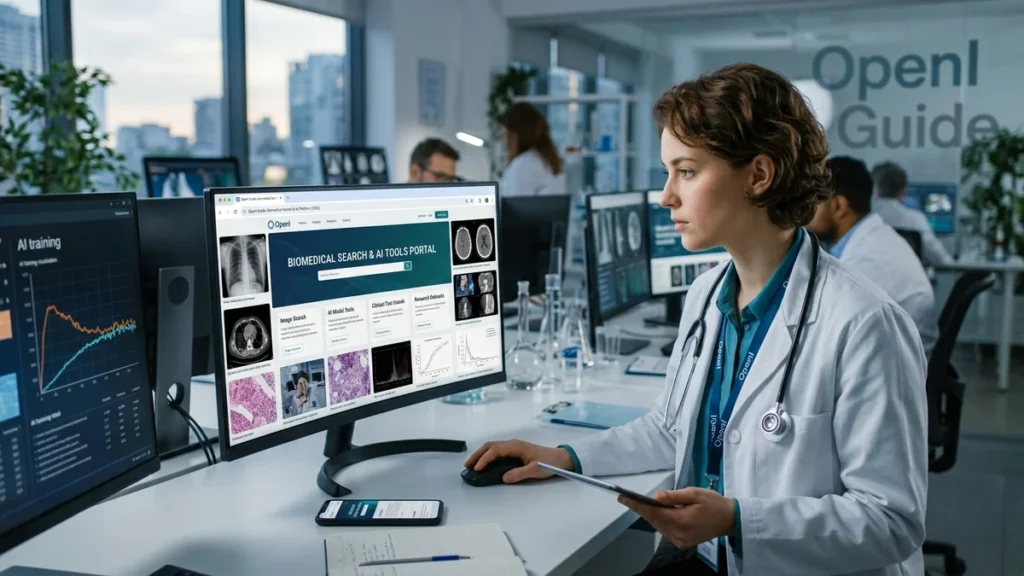
The first time I encountered the term “OpenI,” I was struck by its dual significance. In my analysis of this fascinating name, I have found that “OpenI” refers to two distinct yet equally important entities: the National Library of Medicine’s Open Access Biomedical Image Search Engine and the OpenI open-source artificial intelligence platform. From my perspective, understanding OpenI requires us to explore both meanings and appreciate how this single term encompasses both a powerful medical research tool and a cutting-edge AI development ecosystem.
Based on the available evidence, OpenI serves as both a groundbreaking biomedical image search engine developed by the National Institutes of Health and an open-source AI platform established under China’s national AI strategy. Let us consider the full scope of what OpenI represents across these different domains and explore the unique characteristics of each.
Executive Summary: What You Need to Know About OpenI
| Aspect | Key Information |
|---|---|
| Primary Meanings | NIH biomedical image search engine; OpenI open-source AI platform (启智社区) |
| Open-i (Biomedical Search) | Over 3.7 million images from 1.2 million PubMed Central articles |
| OpenI (AI Platform) | Cluster management tool, resource scheduling platform, open-source AI ecosystem |
| Key Features (Biomedical) | Text and image-based search, outcome statements, clinical images, radiology reports |
| Key Features (AI Platform) | GPU cluster support, microservices architecture, Kubernetes, Hadoop YARN |
| Developers (Biomedical) | NIH, National Library of Medicine, Dina Demner-Fushman, Sameer Antani |
| Developers (AI Platform) | Microsoft Research, Peking University, AITISA, Peng Cheng Laboratory |
In my view, the most important takeaway is that “OpenI” represents a fascinating convergence of open-access principles in both biomedical research and artificial intelligence development, with each interpretation serving critical roles in their respective fields.
Open-i: The NIH Biomedical Image Search Engine
What Is Open-i?
Open-i, pronounced “open eye,” is an experimental multimedia search engine developed by the National Library of Medicine (NLM), part of the National Institutes of Health (NIH). As one library guide describes it, the Open-i service “enables search and retrieval of abstracts and images (including charts, graphs, clinical images, etc.) from the open source literature, and biomedical image collections”. The search engine allows users to find biomedical images using both text queries and by uploading images to find similar visuals.
The significance of Open-i lies in its role as the first production-quality system of its kind in the biomedical domain. According to an NIH publication, just a few months after its public release, the site had more than 5,000 unique visitors per day and was ranked 382nd in the world among 30 million websites.
The Challenge Behind Open-i
Illustrations in medical literature contribute greatly to understanding complex biomedical concepts for researchers, scientists, and the lay public alike. However, bibliographic databases are mostly text-based, creating a need for systems that deliver citations enriched by visual material such as radiographic images, photographs, sketches, graphs, or charts.
This challenge drove IRP researchers Dina Demner-Fushman, M.D., Ph.D., and Sameer Antani, Ph.D., to lead the development of Open-i. Their work created a novel open-access biomedical image search engine that provides outcome—or “take-away”—statements extracted from a collection of 250,000 open-access articles and 1 million illustrations in the biomedical literature hosted at the National Library of Medicine’s PubMed Central repository.
The Scale and Scope of Open-i
Based on the available evidence, Open-i provides access to an impressive collection of biomedical images:
| Collection | Count |
|---|---|
| Images from PubMed Central articles | Over 3.7 million images |
| PubMed Central articles | Approximately 1.2 million |
| Chest X-rays | 7,470 |
| Radiology reports | 3,955 |
| Images from NLM History of Medicine collection | 67,517 |
| Orthopedic illustrations | 2,064 |
The home page interface features a basic search box. However, as the University of Kansas Medical Center’s library guide notes, “to get the most out of the database, users should navigate to the FAQ page,” where the search field is augmented by dropdown menus. These dropdown menus allow users to limit searches by article type, image type, subsets of publication type, pre-defined collections, licensing, medical specialty, and location of keywords in records.
AI is increasingly being used across healthcare settings, from clinical documentation to tools that support professional workflows. These applications differ from biomedical image search, but they illustrate another way artificial intelligence is being applied in healthcare. For a related example, read our guide to AI Bola and AI-powered clinical documentation.
Search by Image: A Powerful Feature
One of Open-i’s most distinctive features is its search-by-image capability. This feature allows a user to upload an image and have the database return similar images, much like Google’s search by image service. To use it, simply click the camera icon to the right of the search field and upload an image you’d like to find similar images of.
The results list displays thumbnail images and bibliographic information regarding the resource the image appears in. Depending on the type of resource the image appears in, hovering your mouse cursor over a particular image thumbnail may display a “Bottom Line” entry, highlighted in grey. These “Bottom Line” entries are automatically generated summaries of the articles that are “most likely to discuss patient-oriented outcomes of the methods presented in the paper”. This feature nicely gives you some context for the image without the need to click.
Applications in Medical Education and Research
Open-i supports medical education and research by providing convenient access to visual biomedical content. The service enables medical professionals and the public to access both highly relevant visual information and key outcome statements from biomedical publications.
The search engine is accessible through various interfaces, including a dedicated website at openi.nlm.nih.gov. Library guides from multiple institutions, including the University of Kansas Medical Center, Harvard Medical School, and the University of Maryland, have highlighted Open-i as a valuable resource for finding medical images.
OpenI: The Open-Source Artificial Intelligence Platform
What Is OpenI?
In a completely different domain, “OpenI” (often referred to as 启智社区 or Qizhi Community) is a Chinese open-source artificial intelligence platform. As described on the official website, “启智社区(简称OpenI)是在国家实施新一代人工智能发展战略背景下,新一代人工智能产业技术创新战略联盟(AITISA)组织产学研用协作共建共享的开源平台与社区”.
The platform is built upon the Peng Cheng Cloud Brain scientific device and the Trustie software development methodology, comprehensively promoting open-source and collaborative innovation in the field of artificial intelligence.
The History and Development of OpenI
OpenI启智社区 was established under China’s national strategy for the development of a new generation of artificial intelligence. According to a TechWeb report, the OpenI启智社区 (English full name Open Intelligence) was jointly built by the New Generation Artificial Intelligence Industry Technology Innovation Alliance (AITISA) through collaboration between industry, academia, and research.
As Huang Tiejun, Secretary-General of AITISA, explained, after two years of construction, the OpenI启智平台 has formed an initial framework for an open-source community platform, divided into three layers: infrastructure hardware, software environment connecting various hardware facilities, and algorithm frameworks.
The community includes over 20 excellent open-source projects, providing a good software and hardware foundation for China’s artificial intelligence development.
The Scale and Reach of OpenI
OpenI启智社区 has become a significant force in China’s AI ecosystem. According to the official website, the community has brought together leading AI companies including Huawei, Baidu, WeBank, SenseTime, Megvii, JD.com, and Xiaomi. It also collaborates with top research institutions such as Peng Cheng Laboratory, Beijing Institute of Artificial Intelligence, Peking University, National University of Defense Technology, and Beihang University.
The community has 11 core member units, with senior or ordinary members being domestic top technology companies, first-class research institutions, or universities. It has formed a governance system aligned with international top open-source organizations and has established a comprehensive support service environment covering collaborative development, code hosting, data sharing, technical training, and multiple subsystems.
OpenI’s Role in China’s AI Strategy
OpenI启智社区 was recognized in the 2021 “Science and Technology China” open-source innovation list as an outstanding open-source community. The platform has laid out four levels of construction: open-source community layer, open innovation research platform layer, open innovation enterprise platform layer, and open-source open node layer.
Fifteen national new-generation AI open innovation platforms are being integrated into OpenI, joining the open innovation enterprise platform layer. Research institutions such as Peng Cheng Laboratory and Beijing Institute of Artificial Intelligence have provided strong support in major infrastructure construction and community development, playing important roles in the open innovation research platform layer.
OpenI-Octopus: The Cluster Management Tool
One of the key projects within the OpenI ecosystem is OpenI-Octopus (启智章鱼), a cluster management tool and resource scheduling platform. According to the GitHub repository, OpenI-Octopus was initially designed and jointly developed by Microsoft Research, Microsoft Search Technology Center, Peking University, Xi’an Jiaotong University, Zhejiang University, and the University of Science and Technology of China.
The platform incorporates mature designs that have a proven track record in large-scale Microsoft production environments and is tailored primarily for academic and research purposes. OpenI supports AI jobs (such as deep learning jobs) running in a GPU cluster.
Technical Architecture of OpenI-Octopus
The platform provides a set of interfaces to support major deep learning frameworks including CNTK and TensorFlow. The interface provides great extensibility: new deep learning frameworks (or other types of workloads) can be supported by the interface with a few extra lines of script and/or Python code.
OpenI supports GPU scheduling, a key requirement for deep learning jobs. For better performance, OpenI supports fine-grained topology-aware job placement that can request GPUs with specific locations (e.g., under the same PCI-E switch).
The platform embraces a microservices architecture: every component runs in a container. The system leverages Kubernetes to deploy and manage static components in the system. The more dynamic deep learning jobs are scheduled and managed by Hadoop YARN with GPU enhancement. The training data and training results are stored in Hadoop HDFS.
An Open AI Platform for R&D and Education
OpenI is completely open under the Open-Intelligence license. It is architected in a modular way, allowing different modules to be plugged in as appropriate. This makes OpenI particularly attractive for evaluating various research ideas, including scheduling mechanisms for deep learning workloads, deep neural network applications requiring evaluation under realistic platform environments, new deep learning frameworks, compiler techniques for AI, high-performance networking for AI, profiling tools, AI benchmark suites, new hardware for AI (including FPGA, ASIC, Neural Processor), AI storage support, and AI platform management.
OpenI operates in an open model where contributions from academia and industry are all highly welcome.
OpenI’s Diverse Project Ecosystem
The OpenI platform hosts a wide range of projects covering various aspects of AI development:
| Project | Description |
|---|---|
| PanGu-α | 200 billion parameter Chinese autoregressive language model |
| OpenBMB | Large-scale pre-trained language model library and related tools |
| ModelBox | AI inference application development framework for edge-cloud scenarios |
| 启智飞桨 | Deep learning and reinforcement learning framework contributed by Baidu |
| 天元 | Deep learning framework open-sourced by Megvii |
| 海参 | Deep learning-based video coding tool |
| OpenRL | Reinforcement learning research framework based on PyTorch |
| 昇思 MindSpore | Full-scenario AI framework |
| 启智章鱼 | One-stop integrated computing platform |
| 启智纵横 | Federated learning computing toolkit |
The Importance of Open-Access Principles
Both interpretations of OpenI share a commitment to open-access principles. The biomedical search engine makes visual medical knowledge freely available to researchers, clinicians, and the public, democratizing access to critical biomedical information. Similarly, the AI open-source platform embodies the principles of open collaboration, shared resources, and community-driven innovation.
As one observer noted, Open-i “enables medical professionals and the public to access both highly relevant visual information and key outcome statements from biomedical publications”. In the same spirit, OpenI启智社区 aims to “build an open, collaborative, and co-constructed AI technology innovation ecosystem”.
Conclusion
Throughout this exploration of OpenI, I have found that this versatile term represents a remarkable diversity of meanings across different fields. The practical lesson is that when you encounter “OpenI,” it is essential to understand the context to know which meaning is being referenced.
I believe the central insight is that the versatility of the term reflects the global and interconnected nature of modern technology and research. A single name can simultaneously represent a biomedical image search engine used by medical professionals worldwide and an open-source AI platform that supports cutting-edge research and development. Each interpretation has its own unique characteristics, history, and community.
From my perspective, the most remarkable aspect is how both interpretations embrace the principle of openness—making knowledge and tools freely available to advance human understanding. For those interested in exploring more about technology, medicine, and open-source innovation, resources like those available at WordPlay-2018 can provide additional insights.
Frequently Asked Questions
What is Open-i?
Open-i is a free, open-access biomedical image search engine developed by the National Library of Medicine (NIH). It allows users to search and retrieve over 3.7 million images from approximately 1.2 million PubMed Central articles, including clinical images, charts, graphs, and radiology reports.
How does Open-i work?
Open-i supports both text-based searches and image-based searches. Users can search using keywords or upload an image to find similar images. The search results display thumbnail images along with bibliographic information and automatically generated “Bottom Line” summaries of the articles.
What is OpenI (启智社区)?
OpenI (启智社区) is an open-source artificial intelligence platform established under China’s national AI strategy. It is a collaborative open-source community organized by the New Generation Artificial Intelligence Industry Technology Innovation Alliance (AITISA), bringing together industry, academia, and research institutions.
What projects are part of the OpenI ecosystem?
The OpenI ecosystem includes over 20 open-source projects, including PanGu-α (200 billion parameter language model), OpenBMB, ModelBox, Baidu’s PaddlePaddle contribution, Megvii’s Tianyuan, and various AI frameworks and tools.
Who developed Open-I?
Open-i was developed by NIH researchers Dina Demner-Fushman, M.D., Ph.D., and Sameer Antani, Ph.D., at the National Library of Medicine.
Who is behind the OpenI AI platform?
OpenI is supported by the Peng Cheng Laboratory, the New Generation Artificial Intelligence Industry Technology Innovation Alliance (AITISA), and involves collaboration with major companies including Huawei, Baidu, WeBank, SenseTime, and leading research institutions.
Is Open-i free to use?
Yes, Open-i is a free, open-access resource provided by the National Library of Medicine. Users can search and retrieve images and abstracts without any charge.
What is OpenI-Octopus?
OpenI-Octopus (启智章鱼) is a cluster management tool and resource scheduling platform within the OpenI ecosystem, initially developed by Microsoft Research and several Chinese universities. It supports AI jobs running in GPU clusters and uses a microservices architecture with Kubernetes and Hadoop YARN.
Sources
- “Find biomedical images easily with Open-i.” University of Kansas Medical Center Library, October 2024.
- “Open your eyes to the power of image-based online searching.” NIH IRP, 2012.
- “Open-i.” Harvard Medical School Library.
- “GitHub – open-intelligence/OpenI-Octopus.” GitHub.
- “启智社区亮相2020全球智博会.” TechWeb, August 2020.
- “OpenI 启智 新一代人工智能开源开放平台.” openi.org.cn.
- “欢迎加入OpenI.” openi.org.cn.
- “启智OpenI开发协作平台.” openi.org.cn, August 2026.
- “Open-i.” NNLM.
Disclaimer
This article provides general information about OpenI for informational and educational purposes. The analysis is based on available public information and may not reflect the most current features or policies of any platform. This article does not constitute an endorsement of any specific product, service, or platform. The views expressed are those of the author based on available evidence. Readers should verify information through official sources before relying on it.

Faizullah Baig
Entertainment & Digital Culture Writer at WordPlay2018
Faizullah Baig is a writer at WordPlay2018 covering entertainment, celebrity news, movies, television, pop culture, and digital trends.
His work focuses on explaining current entertainment stories in a clear and reader-friendly way, with attention to the details behind trending headlines.
Areas of Coverage
Faizullah primarily covers:
Celebrity news and profiles
Movies and television
Entertainment industry developments
Celebrity relationships and public appearances
Trending pop-culture stories
Digital culture and online trends
Editorial Approach
Faizullah aims to distinguish confirmed information from reports, estimates, and speculation. For developing stories, information may be updated as additional reliable details become available.
Articles published under his name are intended to provide readers with useful context rather than simply repeat a headline or social-media claim.
Contact
For corrections, questions, or feedback about an article published under Faizullah Baig’s name, please contact:
Publication: WordPlay2018
Role: Entertainment & Digital Culture Writer