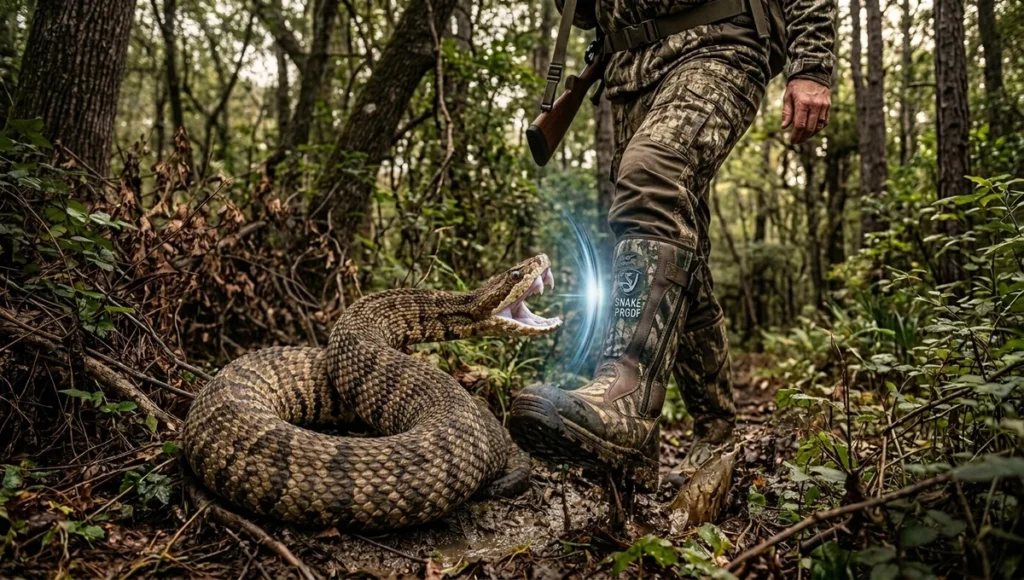
Snake Boots: Waterproof Snake-Resistant Hunting Guide
When I started researching snake boots, I found that buyers are usually looking for much more than a tall pair of outdoor footwear. They want protection from snake strikes, but they also need waterproofing, traction, comfort, durability, and a fit that works during long hours outside.
That combination is what makes choosing snake boots slightly different from choosing ordinary hunting or hiking boots. For example, a regular waterproof boot may keep your feet dry, but that does not automatically mean it has a snake-resistant construction. Similarly, a tall rubber boot may cover more of your leg without being specifically designed or tested for snake protection.
Therefore, I think the best way to approach this category is to look at each feature separately and then consider how they work together.
Current products show how much variation exists. Muck, for example, currently sells certified snake-resistant boots with waterproof construction, while Danner offers a 17-inch Sharptail Snake Boot with waterproof GORE-TEX and a dedicated snake guard. Rocky also offers tall waterproof snake boots designed for hunting and wet terrain.
So, in this guide, I’ll explain what snake boots are, how snake-resistant construction differs from ordinary waterproof footwear, what makes a good hunting boot, and what I would check before buying a pair.
What Are Snake Boots?
Snake boots are specialized outdoor boots designed to provide additional protection around the feet and lower legs in areas where snakes may be present.
Unlike ordinary hiking boots, snake boots generally have a much taller shaft. In addition, qualifying models use protective materials or construction intended to resist snake strikes.
However, the term “snake boot” should not make you assume that every model offers identical protection.
That distinction matters because manufacturers use different materials, designs, testing methods, and protection claims. As a result, I would always check the manufacturer’s specifications for the exact boot rather than relying only on the product name.
Muck currently describes its Wetland Pro Certified Snake Strike Boot as having full-height snake-strike-resistant rubber construction. The company also lists 100% waterproof construction, a 17-inch height, a 5mm neoprene bootie, and a self-cleaning lug outsole.
Meanwhile, Danner’s Sharptail Snake Boot uses a 17-inch design with snake guard protection and a waterproof GORE-TEX liner. Danner says its snake protection extends from the bottom of the foot to the top of the boot.
Therefore, the construction details are much more useful than simply seeing the words “snake boots” on a product page.
Why Do Hunters Wear Snake Boots?
Hunting can take you through exactly the type of terrain where snakes are difficult to see.
For example, hunters may move through:
- Tall grass
- Thick brush
- Marshes
- Mud
- Wet fields
- Forest edges
- Fallen leaves
- Rocky trails
- Creek bottoms
Because of that, ordinary low-cut footwear may not provide the coverage some hunters want in snake country.
A dedicated pair of snake boots can extend protection considerably higher up the leg. In addition, many models combine that protection with waterproofing and aggressive outsoles.
For me, the biggest advantage is therefore the combination rather than any single feature.
A good hunting snake boot can be designed to handle wet ground, rough vegetation, mud, and uneven terrain while also providing a protective upper.
Still, snake boots should not create a false sense of security. They are one part of outdoor safety, not a guarantee against every possible snakebite.
What Makes a Boot Snake Resistant?
This is probably the most important question to answer before buying.
Not every tall boot is snake resistant. Moreover, waterproofing by itself does not make a boot resistant to a snake strike.
Dedicated snake boots use specific protective construction. Depending on the model, this can involve specialized textiles, rubber, protective layers, or combinations of materials.
For example, Danner says its Sharptail uses a flexible snake-protection fabric between the exterior and liner to provide 360-degree protection.
Muck, meanwhile, describes its Wetland Pro as having full rubber coverage to the top of the boot and certification against snake strike.
Rocky also markets its Retraction Waterproof Side-Zip Snake Boot with snakeguard material and a 17-inch shaft.
Therefore, when I compare snake boots, I would look for specific manufacturer information about:
- Snake-resistant construction
- Snake guard material
- Strike protection
- Protective coverage
- Testing or certification
- Shaft height
- Intended use
Most importantly, I would avoid assuming that two boots provide exactly the same protection simply because both are advertised as snake boots.
Are Snake Boots Waterproof?
Many snake boots are waterproof, but snake protection and waterproofing are still two separate features.
That distinction is important.
A waterproof boot is designed to keep water from entering the footwear. A snake-resistant boot, on the other hand, is designed around protection from snake strikes. Therefore, a boot can have one feature without necessarily having the other.
Fortunately, many current models combine both.
Muck’s current certified snake-boot range specifically promotes waterproof protection alongside snake resistance. Its Wetland Pro model is listed as 100% waterproof and has a full-height snake-strike-resistant rubber construction.
Similarly, Danner’s Sharptail Snake Boot uses waterproof GORE-TEX construction. The company also describes the boot as designed for bird hunting and snake protection.
Rocky’s Retraction model is another example. It combines a 17-inch shaft, snakeguard material, full-grain leather, 900-denier nylon, and guaranteed Rocky Waterproof construction.
So, if you frequently hunt in wet grass, marshes, mud, or rainy conditions, I would specifically look for a model where both protection and waterproofing are clearly documented.
| Feature | Why It Matters |
|---|---|
| Snake-resistant construction | Provides dedicated protection against snake strikes |
| Waterproof construction | Helps keep feet dry in wet terrain |
| Tall shaft | Extends coverage above the ankle |
| Traction outsole | Helps maintain grip on mud and uneven ground |
| Breathable lining | Can improve comfort during long wear |
| Side zipper | Makes tall boots easier to put on and remove |
| Cushioned footbed | Can reduce fatigue during long walks |
How Tall Should Snake Boots Be?
There is no single height that works for everyone. However, many dedicated snake boots are considerably taller than normal hiking boots.
Current examples show this clearly.
Muck’s Wetland Pro is listed at 17 inches, while Danner’s Sharptail Snake Boot is also 17 inches. Rocky’s Retraction Waterproof Side-Zip Snake Boot is likewise 17 inches tall.
That does not mean 17 inches is automatically the right height for every hunter.
Instead, I would consider the terrain, vegetation, expected snake exposure, and how much leg coverage I actually need.
A taller shaft can provide more coverage. However, it can also add weight, heat, and bulk.
Therefore, the goal should be to find the right balance between protection and practical comfort.
Snake Boots for Wet and Swampy Terrain
If you spend a lot of time in wet terrain, waterproofing becomes especially important.
Swamps, marshes, muddy fields, and wet grass can quickly soak ordinary footwear. As a result, a waterproof snake boot can make the outdoor experience considerably more comfortable.
Rubber construction is particularly common in this type of environment.
Muck’s Wetland Pro, for example, uses full rubber coverage and is designed for wet outdoor conditions. Its outsole is also marketed for mud, snow, and dirt.
Likewise, Rocky describes its Retraction model as suitable for severe wet conditions and combines waterproof construction with snakeguard material.
However, waterproof rubber boots can feel warm during hot weather.
For that reason, I would not choose a boot solely because it is waterproof. Instead, I would consider the climate, activity level, insulation, lining, and expected walking distance.
Snake Boots for Dry Hunting Terrain
Dry terrain creates a different set of priorities.
If you are hunting in relatively dry woodland, brush, or open terrain, you may care more about weight, flexibility, breathability, and long-distance comfort.
Leather and textile combinations can be useful here.
Danner’s Sharptail, for example, combines full-grain leather with durable textile construction, while also including snake guard protection and waterproof GORE-TEX.
Similarly, Rocky’s Retraction uses full-grain leather and 900-denier nylon. The company combines those materials with a 17-inch shaft and snakeguard material.
Therefore, I would think about the terrain before deciding between a heavy rubber boot and a leather-textile hunting boot.
Rubber vs. Leather Snake Boots
Material can make a noticeable difference in how snake boots feel.
Rubber Snake Boots
Rubber boots are particularly useful when water and mud are major concerns.
They can work well for:
- Marsh hunting
- Wet fields
- Swamps
- Rainy conditions
- Muddy ground
- Waterfowl environments
In addition, rubber can provide a continuous outer layer around the foot and lower leg.
However, rubber can also feel warmer and heavier, especially during summer hunting.
Leather and Textile Snake Boots
Leather and textile combinations can offer a more traditional hunting-boot feel.
They may be attractive for hunters who spend more time walking through dry or mixed terrain. Furthermore, some models combine leather and textile materials with waterproof membranes and dedicated snake protection.
Danner’s Sharptail is a current example of this approach. It combines full-grain leather, durable textile construction, waterproof GORE-TEX, and a snake guard.
| Construction | Best Suited For | Main Advantage | Possible Trade-Off |
|---|---|---|---|
| Rubber | Wetlands and mud | Waterproof protection | Can feel warm |
| Leather | Dry hunting terrain | Durable traditional feel | Requires care |
| Leather + textile | Mixed terrain | Balance of durability and flexibility | Features vary by model |
| Rubber + neoprene | Wet outdoor use | Waterproof and cushioned | Can retain heat |
What Should You Look for in Snake Boots?
When I compare snake boots, I would use a simple checklist.
1. Snake Protection
First, verify the actual protection claim.
Look for terms such as snake resistant, snake guard, snake strike resistant, or a manufacturer’s specific certification.
However, do not assume that similar terminology means identical performance.
2. Shaft Height
Next, check the actual boot height.
A photograph can make a boot appear taller than it really is. Therefore, the listed measurement is much more useful.
Many current models are around 16 to 17 inches, although shorter snake-protection boots also exist. For example, Academy currently lists an 8-inch Rocky ProLight Waterproof Snake Protection Hunting Boot.
This shows why the intended use matters more than choosing a particular height simply because it is popular.
3. Waterproofing
If you hunt in wet conditions, verify whether the manufacturer calls the boot waterproof.
Water resistant and waterproof are not interchangeable terms.
For example, Danner explicitly lists the Sharptail as waterproof with a GORE-TEX liner, while Rocky identifies its Retraction model as having guaranteed waterproof construction.
4. Fit Around the Calf
Tall snake boots need to fit properly around the calf.
If the opening is too tight, the boot may become uncomfortable. On the other hand, if it is too loose, it may not work well with your clothing or preferred fit.
Therefore, check calf measurements as carefully as shoe size.
5. Weight
Protection is important, but weight matters during long hunts.
A boot that feels manageable for a few minutes can feel very different after several hours.
For example, current manufacturers publish weight information for some models. Muck lists its Wetland Pro at about 3 pounds per pair in size 10, while Rocky lists its Retraction at about 2.15 pounds per pair in size 10.
Because weight varies by size and model, I would use manufacturer specifications as a comparison point rather than assuming one material is always lighter.
6. Traction
Snake country is not always flat or dry.
Mud, leaves, rocks, and wet ground can create slipping hazards. Therefore, an aggressive outsole can be just as useful as waterproofing.
Muck’s Wetland Pro uses a self-cleaning lug outsole designed for mud, snow, and dirt, while Danner’s Sharptail uses its Sharptail outsole for traction over rugged terrain.
Snake Boots vs. Regular Hunting Boots
The two categories can look similar, but their intended features can be very different.
Regular hunting boots may focus on insulation, waterproofing, comfort, traction, or ankle support.
Snake boots add another priority: protection around the lower leg.
| Factor | Snake Boots | Regular Hunting Boots |
|---|---|---|
| Snake protection | Available on qualifying models | Not necessarily included |
| Shaft height | Often tall | Usually varies |
| Waterproof options | Common | Depends on model |
| Wet-terrain use | Many models suitable | Model dependent |
| Weight | Can be heavier | Often lighter |
| Lower-leg coverage | Greater on tall models | Usually more limited |
| Main purpose | Snake country + outdoor use | General hunting |
Therefore, if snake exposure is one of your main concerns, I would start by looking specifically at snake-protection specifications rather than buying an ordinary hunting boot and assuming it provides the same protection.
Snake Boots vs. Snake Gaiters
Snake gaiters provide another way to protect the lower legs.
Instead of purchasing dedicated snake boots, someone can wear protective gaiters over existing outdoor footwear.
This can be useful if you already own comfortable hiking or hunting boots.
However, the two approaches are different.
With snake boots, the protective construction is integrated into the footwear. With gaiters, the protective layer is added separately.
Therefore, I would compare:
- Coverage
- Weight
- Comfort
- Waterproofing
- Fit
- Ease of use
- Manufacturer protection specifications
Neither approach should be treated as universally perfect.
Instead, the better option depends on the terrain and the rest of your outdoor gear.
You should also know about BuckViz Boots: Waterproof Hi-Vis Safety Boots Guide
Are Snake Boots Comfortable?
They can be, but comfort depends heavily on the model and your intended use.
Tall protective boots naturally contain more material than ordinary footwear. As a result, they can feel heavier or warmer.
However, manufacturers have added comfort-focused features to many current designs.
Muck’s Wetland Pro, for example, uses a 5mm neoprene bootie, 3D Airmesh lining, and an EVA midsole.
Danner’s Sharptail includes an OrthoLite footbed and a GORE-TEX liner designed to remain waterproof while allowing moisture to escape.
Rocky’s Retraction uses an EnergyBed footbed with memory foam and a moisture-wicking lining.
Therefore, comfort should not be treated as an afterthought.
When comparing snake boots, I would check the:
- Footbed
- Midsole
- Lining
- Weight
- Calf fit
- Insulation
- Flexibility
- Closure system
Side-Zip vs. Pull-On Snake Boots
Tall boots can sometimes be difficult to put on and remove.
That is why a side zipper can be useful.
Danner’s Sharptail Snake Boot, for example, combines lacing with a side zipper. Rocky’s Retraction model also uses an interior side zipper.
As a result, these designs may be convenient for people who do not want to struggle with pulling a tall boot over the calf.
On the other hand, a pull-on design can be simple and practical.
So, I would choose based on convenience rather than assuming one closure type is automatically better.
Men’s Snake Boots for Warm Weather
Warm weather creates a particular challenge.
A tall waterproof boot may protect well from mud and water, but it can also trap heat.
Therefore, if I were buying snake boots for summer hunting, I would pay close attention to:
- Breathability
- Lining
- Insulation
- Weight
- Moisture management
- Ventilation
- Comfort over long periods
Muck’s Viper Max, for example, combines a breathable airmesh lining with a 5mm neoprene bootie and a 17-inch height. The company also lists a snake-resistant textile with a sheet-rubber upper and 100% waterproof construction.
However, a product’s comfort range and materials still need to be matched to your local climate and activity.
How I Would Choose Snake Boots
If I were comparing several models, I would follow a simple order.
First, I would check protection.
There is little reason to focus on color or appearance before confirming that the boot actually provides the type of snake protection I need.
Next, I would consider terrain.
For swampy or muddy ground, waterproof rubber construction would be high on my list. In contrast, for dry terrain and longer walks, I would compare leather and textile models more closely.
Then, I would check height and fit.
A 17-inch boot is not automatically better for every person than a shorter design. Instead, the height should make sense for the terrain and expected exposure.
After that, I would compare weight and comfort.
This becomes especially important if the boots will be worn for several hours.
Finally, I would look at maintenance, warranty, and return policies.
Even a well-designed boot can be the wrong purchase if the fit is poor.
Snake Boots and Outdoor Safety
Snake boots are useful protective equipment, but they should never replace basic outdoor awareness.
The National Park Service advises people in snake country to watch where they place their feet and avoid putting hands or feet into areas they cannot see.
In addition, the CDC recommends appropriate protective clothing, including boots and long pants, for outdoor workers in areas where venomous snakes may be present.
Therefore, I would combine protective footwear with sensible behavior.
That means watching the trail, avoiding hidden holes and brush where visibility is poor, and giving snakes plenty of space when encountered.
Moreover, I would never try to catch, handle, or deliberately approach a snake simply because I am wearing protective boots.
What If a Snake Bites You?
Snake boots can reduce risk, but they should never be treated as a guarantee.
If a snakebite occurs, medical attention should be sought immediately.
In particular, I would not rely on home remedies or attempt to treat a potentially venomous bite myself.
The CDC’s guidance on venomous snakes emphasizes prompt medical care after a suspected venomous bite.
Therefore, the purpose of snake boots should be viewed realistically: they are protective equipment designed for a particular risk, not a replacement for medical treatment or outdoor awareness.
Final Thoughts on Snake Boots
The right snake boots depend on where you plan to use them.
If your main environment is swampy or wet, waterproof rubber construction may be the most practical choice. On the other hand, if you spend long hours walking through dry woodland, a leather and textile design may offer a different balance of weight, flexibility, and protection.
Most importantly, I would verify the manufacturer’s actual snake-protection specifications.
A tall boot is not automatically a snake-resistant boot. Likewise, a waterproof boot is not automatically designed to resist a snake strike.
Current models from Muck, Danner, and Rocky demonstrate several different approaches, including full-height rubber construction, protective textiles, leather-and-nylon uppers, waterproof membranes, and tall 17-inch shafts.
Ultimately, I would choose the boot according to the terrain, weather, activity, fit, and level of protection required.
And above all, I would remember that good footwear is only one part of staying safe in snake country.
FAQ About Snake Boots
What are snake boots?
Snake boots are specialized outdoor boots designed to provide additional protection against snake strikes while also supporting activities such as hunting, hiking, ranch work, and outdoor work.
Are snake boots waterproof?
Many current snake boots are waterproof, but not all models necessarily are. Therefore, check the manufacturer’s specifications before buying. Muck, Danner, and Rocky currently offer snake boots with waterproof construction.
How tall are snake boots?
Many dedicated snake boots are around 16 to 17 inches tall. However, shorter snake-protection models are also available, so height should be selected according to terrain and intended use.
Are all tall rubber boots snake resistant?
No. A tall rubber boot may provide coverage and waterproofing without having dedicated snake-resistant construction. Always check the manufacturer’s protection specifications.
Are snake boots good for hunting?
Yes, dedicated snake boots are commonly designed for hunting and outdoor use. Current products from Muck, Danner, and Rocky specifically include hunting or outdoor applications in their descriptions.
Are leather snake boots waterproof?
Some are. For example, Danner’s Sharptail Snake Boot combines full-grain leather and textile construction with a waterproof GORE-TEX liner.
Are rubber snake boots better for wet terrain?
Rubber models can be particularly practical for marshes, mud, rain, and other wet conditions because waterproof construction is common in this category. However, heat and weight should also be considered.
Can snake boots prevent every snakebite?
No footwear should be treated as an absolute guarantee. Protection depends on the specific boot, its construction, the snake, and the circumstances of an encounter.
Are snake boots comfortable for long hunts?
They can be, but comfort varies. Weight, lining, footbed, calf fit, insulation, and shaft construction all affect how a boot feels over several hours.
Should I choose 16-inch or 17-inch snake boots?
The better height depends on your terrain, activity, and preferred coverage. A taller boot provides more coverage, but it can also add weight and heat. Therefore, choose based on actual use rather than height alone.
Are snake gaiters an alternative to snake boots?
Yes. Snake gaiters can be worn over existing hunting or hiking boots. However, dedicated snake boots integrate the protective construction into the footwear itself, so compare the specifications of both options carefully.
Sources and References
- The Original Muck Boot Company — Certified Resistant Snake Boots and current product specifications
- The Original Muck Boot Company — Snake Boot buying guide
- Danner — Sharptail Snake Boot specifications
- Rocky Boots — Retraction Waterproof Side-Zip Snake Boot specifications
- Academy — Rocky ProLight Waterproof Snake Protection Hunting Boot
- National Park Service — Outdoor and snake-safety guidance
- CDC/NIOSH — Venomous snake safety guidance
Disclaimer: This article is for general informational purposes only. Snake-boot protection varies by product, manufacturer, testing method, and conditions. Always read the manufacturer’s current specifications before purchasing or relying on protective footwear. Snake boots do not eliminate the risk of injury. If you suspect a venomous snakebite, seek emergency medical attention immediately.

Tech & Entertainment journalist covering automotive launches, trending media, and digital culture at Wordplay2018