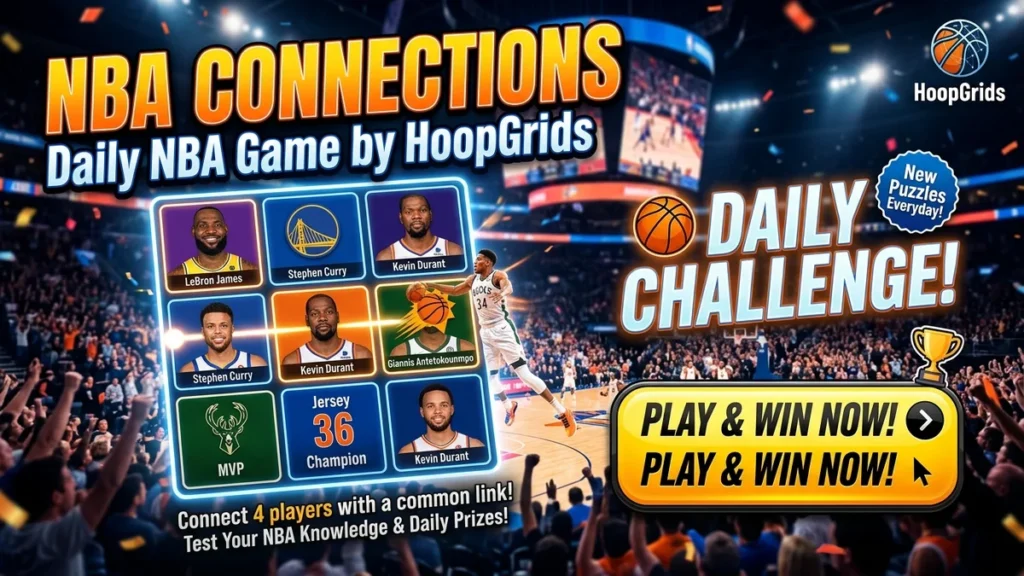
Introduction to NBA Connections Daily NBA Game by HoopGrids
I have found that basketball puzzle games become much more interesting when they require more than simple player recognition. NBA Connections takes that idea and turns it into a daily challenge built around patterns, relationships, and NBA knowledge.
The game is presented by HoopGrids, and its central task is straightforward: identify four groups of four NBA players that share a meaningful connection. The connection might involve a team, a season, an achievement, a physical trait, or another common experience. The challenge comes from the fact that several players can appear to fit more than one possible group.
From my perspective, that uncertainty is what gives NBA Connections its appeal. You are not simply answering a trivia question. You are comparing possibilities and deciding which relationship is strong enough to justify a guess.
The official HoopGrids game explains the objective in simple terms: “The goal is to find and select four groups of four players who share a connection.” HoopGrids, NBA Connections.
That description captures the basic mechanic, but it does not fully explain the reasoning involved. We need to look at the board as a puzzle rather than as a collection of unrelated player names.
In this guide, I will explain how NBA Connections works, what kinds of relationships can appear, how the difficulty system helps, how hints work, and how I would approach a difficult board without wasting guesses.
I will also cover common mistakes, practical solving methods, and ways to improve your pattern-recognition skills over time. The goal is not to reveal a particular day’s answers. Instead, I want to explain the game well enough that you can approach future puzzles with a clearer strategy.
Key Takeaways for NBA Connections Players
Before getting into the deeper strategy, I think it helps to establish the most important ideas.
NBA Connections gives you a collection of NBA players and asks you to organize them into four groups. Each group contains four players connected by one shared idea.
The connection can vary considerably. A group might consist of players who played for the same franchise. Another could involve an award, draft year, college, achievement, or other basketball-related characteristic.
The official game description notes that connections can be based on “teams, years played, physical attributes, achievements, or any other common trait or experience.” HoopGrids, NBA Connections.
That wide range makes the game harder than it first appears. You cannot rely on one category type every day.
I believe the biggest lesson is simple: do not commit to a group merely because four names appear to fit it.
Instead, examine the remaining names and ask whether the same players could create another legitimate group. This matters because a good Connections puzzle can deliberately place tempting relationships beside the correct ones.
The game also provides hints. According to the official instructions, a small hint can reveal two players from the next easiest connection, while a big hint reveals the text of the next easiest connection.
That means hints do not necessarily remove the entire puzzle. They can instead reduce uncertainty and help you continue solving.
What Is NBA Connections?
NBA Connections is a daily basketball puzzle from HoopGrids that asks players to organize NBA names into connected groups.
The standard structure uses 16 players. Your task is to find four separate groups, with four players in each group.
The important part is that the relationship is shared by every member of the group.
For example, imagine a hypothetical board containing 16 players. Four of those players might have played for the Boston Celtics. Another four might have won the NBA MVP award. A different four might have attended the same college.
Those examples are only hypothetical illustrations. They are not claims about a specific daily puzzle.
The final group would contain the four remaining players and their own shared connection.
This structure creates a useful solving principle: every correct group changes the entire puzzle.
Once you remove four players, you are left with 12. After another correct group, only eight remain. At that point, the possible relationships become easier to compare.
From my perspective, this is why the game rewards patience. You do not necessarily need to recognize every connection immediately. You need to identify enough reliable relationships to reduce the board.
Why the Game Feels Different From Regular NBA Trivia
Traditional NBA trivia usually asks a direct question.
For example, a trivia question might ask which player won a specific award or which team won a championship in a particular season.
NBA Connections works differently.
The board gives you the answers first. The challenge is discovering what those answers have in common.
That creates a reverse-trivia experience.
Instead of asking:
“Who won this award?”
you may be looking at four names and asking:
“What award do these four players share?”
That change in direction requires a different mental process.
I think this is one reason the game can appeal to both serious NBA fans and casual basketball followers. You may know a lot about players but still struggle with a particular connection because the relationship is presented indirectly.
How NBA Connections Daily NBA Game by HoopGrids Works
The game begins with a board containing NBA player names.
Your job is to select four names that you believe share one connection.
After selecting four players, you submit your guess.
If the group is correct, the game identifies the connection and removes those players from the active puzzle. You then continue with the remaining names.
If the group is incorrect, you lose an opportunity.
The official HoopGrids page also uses different colors to communicate difficulty. Easier connections receive one color, while harder connections receive another.
This creates an additional strategic element.
A player might notice an apparently obvious group and submit it immediately. However, a more careful player may first examine whether the four names belong to another possible category.
That distinction matters because the strongest strategy is not simply “find four players.” It is “find four players whose connection remains valid after considering the entire board.”
A Simple Hypothetical Example
Imagine that a fictional board contains these names:
- Player A
- Player B
- Player C
- Player D
- Player E
- Player F
- Player G
- Player H
- Player I
- Player J
- Player K
- Player L
- Player M
- Player N
- Player O
- Player P
Suppose A, B, C, and D all played for the same franchise.
That looks like an obvious group.
But imagine A, B, C, and E also share another legitimate characteristic. Now you have an overlap.
This is where you should slow down.
The correct group must make sense within the whole board. You should look for the combination that leaves a clean and credible set of remaining groups.
That is the central reasoning pattern I recommend using.
What Types of Connections Can Appear?
One of the most important aspects of NBA Connections is variety.
If every puzzle used only team affiliations, the game would become predictable. Instead, connections can involve several parts of NBA history and player information.
HoopGrids specifically describes connections involving teams, years played, physical attributes, achievements, common traits, and experiences.
The following table summarizes the major types of relationships a player may encounter.
| Connection Type | What You Look For | Example of a Hypothetical Clue |
|---|---|---|
| Team or franchise | Players connected to the same NBA organization | Four players who played for one franchise |
| Years or era | Players whose careers overlap in a particular period | Four players active during a specified era |
| Achievements | Shared awards, milestones, or accomplishments | Four players who earned the same major honor |
| Physical attributes | A shared measurable player characteristic | Four players with a particular listed trait |
| Career experience | A notable event or shared career path | Four players who experienced a specific NBA milestone |
| Other traits | A less obvious common characteristic | Four players connected by a specialized fact |
The key takeaway is that you should avoid assuming the category before examining the evidence.
A player may immediately remind you of a team. Another player may remind you of an award. But the puzzle may be asking you to recognize a completely different relationship.
I believe flexible thinking is more useful than memorizing a fixed list of categories.
How I Approach a New NBA Connections Board
When I look at a new board, I would not immediately click four names.
First, I would scan all 16 players.
I want to identify obvious relationships before making a commitment.
For example, if four players clearly share a franchise connection, I would mark that mentally as a possible group. But I would continue scanning instead of submitting immediately.
Next, I would search for stronger or more specific relationships.
A broad connection such as “played for the Lakers” can be tempting. However, if one of those players also fits a much more specific group, the broader category may be misleading.
This is where I find the game becomes a test of elimination.
The question is not simply:
“Can these four players fit this category?”
The better question is:
“Does this category explain these four players better than the other available possibilities?”
That small change can prevent unnecessary mistakes.
Step 1: Scan All 16 Names
I recommend reading every player before making your first guess.
Look for names you recognize immediately.
You might notice:
- Four former teammates
- Several MVP winners
- Multiple players from one franchise
- Players from the same draft class
- Players with an unusual shared achievement
- Players with a common physical characteristic
Do not try to solve everything at once.
The first scan is simply about collecting possibilities.
Step 2: Identify the Strongest Anchor
An anchor is a player or group that provides a strong clue.
For example, suppose three players are strongly associated with one award and you know a fourth player who also won it.
That fourth name can become an anchor.
Similarly, if three players have an obvious franchise connection, look at the remaining names for the fourth.
An anchor reduces the search space.
Step 3: Test the Fourth Player Carefully
Finding three related players is often easier than finding the fourth.
This is where I would be especially cautious.
If three players share a clear connection, ask which remaining name completes it.
Do not simply choose the player who feels closest.
Verify the connection.
For a historical category, this may require remembering the exact award, season, franchise, or achievement rather than relying on a general impression.
Step 4: Check for Red Herrings
A red herring is a player who appears to fit a tempting category but actually belongs somewhere else.
This is one of the most important concepts in Connections-style games.
Imagine four players who all played for a famous team. If one of them also shares a much more precise achievement with three other names, the team connection may be the trap.
I believe this is where experienced players gain an advantage. They learn to distinguish a possible connection from a confirmed connection.
Using Difficulty Colors Without Overthinking Them
The official HoopGrids game uses four colors to represent different difficulty levels.
The easiest category is intended to be more recognizable. The hardest category requires more specific knowledge or lateral thinking.
I would treat these colors as information rather than as a reason to guess immediately.
An easy-looking category can still create confusion if it overlaps with another relationship.
Likewise, a difficult category may become obvious once you remove the easier groups.
This creates a natural solving order.
In my view, the safest general approach is to solve the most certain group first. Then use the reduced board to understand the remaining categories.
Why Solving One Group Changes Everything
Suppose the board begins with 16 names.
After solving one group, only 12 remain.
After a second group, eight remain.
At eight names, you are no longer comparing 16 possible players. The puzzle has become much smaller.
That is why elimination is so valuable.
You do not need perfect knowledge of the whole board. You need enough certainty to make progress.
You should also know about treasury direct login
Smart Ways to Use NBA Connections Hints
Hints can be useful when you are stuck, but I would not treat them as a replacement for reasoning.
HoopGrids provides two hint levels.
The smaller hint reveals two of the four players belonging to the next easiest difficulty. The larger hint reveals the text of the next easiest connection.
These options provide different amounts of assistance.
A small hint can be useful when you already suspect a category but cannot identify all four players.
A big hint is more direct because it gives you the connection itself.
The important thing is to use a hint strategically.
For example, suppose you have already identified a likely category but cannot find the final player. A small hint may provide enough information without giving away the entire relationship.
If you genuinely do not understand the remaining board, the larger hint can help you move forward.
I think the best use of hints is educational. When you receive a hint, take a moment to understand why the players belong together instead of simply treating the revealed information as an answer.
A Practical Comparison of Solving Approaches
Different players naturally use different methods. The table below compares several common approaches.
| Solving Approach | Main Strength | Main Weakness | When It Helps |
|---|---|---|---|
| Immediate guessing | Very fast | High risk of false connections | When a group is extremely obvious |
| Full-board scanning | Reduces impulsive guesses | Takes more time | Most daily puzzles |
| Anchor-first solving | Creates a strong starting point | Requires recognition of a strong clue | When several players stand out |
| Elimination | Makes later groups easier | Depends on earlier correct groups | After one or two groups are solved |
| Hint-assisted solving | Reduces uncertainty | Reveals part of the puzzle | When you are genuinely stuck |
| Historical research mindset | Helps with obscure facts | Can slow the game | Hard or niche categories |
From my perspective, full-board scanning combined with anchor-first solving provides a balanced approach.
You can still move quickly, but you avoid turning every familiar relationship into an automatic guess.
Common Mistakes Players Make
Even experienced NBA fans can make mistakes in Connections because familiarity can sometimes create overconfidence.
Mistake 1: Guessing Four Famous Players Together
Four superstar names may feel connected simply because they are famous.
That does not mean they belong in the same group.
A good connection needs a specific shared trait.
Popularity is not a category.
Mistake 2: Stopping After Finding Three Players
Three matching names are not enough.
You need four.
If you cannot identify the fourth player confidently, continue scanning.
The missing player may reveal that your original interpretation was incorrect.
Mistake 3: Ignoring the Remaining Players
This is one of the easiest ways to fall into a trap.
A group can look correct when viewed alone.
But when you consider the remaining 12 names, another arrangement may make more sense.
Always evaluate a possible group against the rest of the board.
Mistake 4: Treating a Broad Connection as Definitive
“Played for the same team” is broad.
A more specific relationship can be stronger.
For example, a set could share a particular award or draft class while also having a franchise connection.
When two categories overlap, specificity becomes important.
Mistake 5: Using Hints Too Early
Hints exist for a reason, and using them is not a failure.
Still, I would give myself a short opportunity to solve the board independently before requesting help.
That makes the game more rewarding and improves pattern recognition.
How NBA Knowledge Helps With Connections
You do not need to know every NBA statistic to play well.
However, broad basketball knowledge can make certain categories easier to recognize.
Knowledge of franchises helps with team-based groups.
Knowledge of NBA awards helps with achievement-based groups.
Knowledge of player careers helps with year and experience-based categories.
Knowledge of player profiles can help when the connection involves physical attributes.
This means NBA Connections can gradually become a learning tool.
Every difficult puzzle can introduce a relationship you did not immediately remember.
I believe the best long-term improvement comes from understanding why a connection exists.
If you simply memorize today’s four answers, the benefit is limited.
If you understand the underlying relationship, you may recognize a similar pattern in a future puzzle.
Why Historical NBA Knowledge Matters
Modern NBA fans may know current stars extremely well.
Historical categories can create a different challenge.
A player may have played decades ago, and the connection may involve an award, franchise, or achievement that is less familiar to newer fans.
This creates a useful reason to broaden your basketball knowledge.
You do not necessarily need to memorize every player.
Instead, focus on major franchises, awards, eras, draft history, and career milestones.
For example, if a future puzzle contains several retired players, knowing their franchises and major achievements can quickly narrow the possibilities.
This is especially helpful when a board mixes players from different generations.
A Second Practical Table: What to Check Before Submitting
I find that a short mental checklist can prevent many unnecessary mistakes.
| Question Before Submission | Why It Matters |
|---|---|
| Do all four players share the same specific trait? | Confirms the category is real |
| Could one of these players fit another group? | Helps detect overlaps |
| Does the group leave sensible players behind? | Tests the board as a whole |
| Is the connection specific enough? | Prevents broad assumptions |
| Can I explain the relationship in one sentence? | Confirms that the category is clear |
| Am I guessing because the names simply feel related? | Identifies emotional or familiarity-based guesses |
| Would a small hint resolve the uncertainty? | Helps decide whether assistance is worthwhile |
The biggest takeaway is that a correct group should be explainable.
If you cannot clearly explain why four players belong together, I would hesitate before submitting.
How to Improve at NBA Connections Over Time
Improvement does not require playing for hours every day.
A consistent short routine can be enough.
After each puzzle, think about the categories you missed.
Ask yourself why you failed to see them.
Was the problem:
- A missing piece of NBA knowledge?
- A misleading player?
- An unfamiliar historical fact?
- A broad category that distracted you?
- A failure to inspect the remaining players?
Each mistake gives you useful information.
For example, suppose you repeatedly struggle with draft-related categories. You could spend some time reviewing major NBA draft classes.
If awards cause difficulty, learn the basic award history of prominent players.
If franchise connections cause problems, become more familiar with player career paths.
This turns the daily game into a small learning routine.
How I Would Handle a Very Difficult Board
When a board looks extremely difficult, I would slow down rather than start clicking randomly.
First, I would identify every obvious relationship.
Second, I would mark uncertain relationships mentally.
Third, I would search for a group with the strongest evidence.
Fourth, I would submit only when the connection feels specific enough.
If I make a mistake, I would treat that result as information.
An incorrect group tells me that at least one assumption was wrong. That can help eliminate possibilities.
This mindset matters because a mistake does not have to end the learning process.
It can show you which relationship was weaker than it appeared.
The Role of Pattern Recognition
At its core, NBA Connections is a pattern-recognition game.
You are comparing names and looking for hidden structure.
That structure can be statistical, historical, geographical, chronological, or related to a player’s career.
Pattern recognition improves when you learn to move between broad and narrow thinking.
Broad thinking asks:
“What do these players have in common?”
Narrow thinking asks:
“What exact fact connects these four players?”
Both are necessary.
If you remain too broad, many players may seem connected.
If you become too narrow too quickly, you may overlook the obvious group.
The strongest solving process moves between both levels.
Why NBA Connections Can Be More Difficult Than It Looks
The rules are simple.
The reasoning is not.
That difference explains much of the game’s appeal.
Anyone can understand the instruction to group four players.
The difficulty comes from identifying the hidden rule behind the group.
A board may contain players who share several superficial similarities. The challenge is separating the intended relationship from the accidental ones.
I think that is also why the game can create a satisfying moment when a difficult group suddenly becomes obvious.
You may spend several minutes looking at the same names. Then one connection becomes clear, and the remaining board suddenly makes sense.
Verified Insight From HoopGrids
The official HoopGrids instructions provide an important clue about how the game’s design works.
The game says:
“Connections could be based on their teams, years played, physical attributes, achievements, or any other common trait or experience.”
HoopGrids, NBA Connections.
I consider this useful because it tells players not to limit their thinking to teams or awards. The game can draw from a much wider range of player information.
That means a successful solver needs flexibility.
When the obvious team-based group does not work, move to another type of relationship instead of forcing the same idea.
Understanding the Game’s Difficulty System
HoopGrids explains that successful connections are assigned one of four colors according to how difficult they are to find.
The easiest category should generally be more recognizable.
The hardest category can require more specific knowledge or a less obvious connection.
This system adds another layer of feedback.
If you solve a difficult group, you know you identified a less obvious relationship.
If you struggle with the hardest category, that does not necessarily mean you played badly. It may simply require knowledge outside your strongest area of NBA history.
I would therefore avoid treating the difficulty color as a score of basketball knowledge.
It is better understood as information about the puzzle’s intended challenge.
NBA Connections as a Daily Habit
Daily puzzle games work partly because they create a small recurring challenge.
NBA Connections fits that structure naturally.
A player can open the game, examine the board, solve the categories, and return the following day for a new challenge.
I think this format works especially well for basketball because the NBA contains an enormous amount of historical information.
Every player has a career history.
Every franchise has a history.
Awards, drafts, seasons, statistics, teammates, and achievements create thousands of possible relationships.
That gives the puzzle format a large knowledge base to draw from.
How to Share the Experience Without Spoiling Answers
Daily puzzles are often more enjoyable when players compare results with friends.
However, spoilers can reduce the fun for someone who has not played yet.
I recommend sharing your result or completion experience without immediately posting the four answers.
A spoiler-free message can simply say that you solved the puzzle or mention how difficult it felt.
If you are discussing the puzzle publicly, identify whether your message contains answers.
That small courtesy allows other players to enjoy the challenge themselves.
Can Beginners Play NBA Connections?
Yes, beginners can play NBA Connections even if they do not have encyclopedic NBA knowledge.
The game does reward basketball familiarity, but beginners can learn through repeated play.
Start by looking for obvious relationships.
Do not worry about solving the hardest category immediately.
If you get stuck, use the available hints.
Most importantly, pay attention to why the correct group works.
Over time, you will recognize more players, teams, awards, and career patterns.
For a beginner, I think the best goal is not a perfect result every day.
The better goal is improving your ability to recognize relationships.
Can Casual NBA Fans Enjoy It?
Casual fans can also enjoy the format because the puzzle does not require every player to be familiar before the game starts.
One or two recognizable names may provide the first clue.
Once one group is removed, the remaining board becomes easier to analyze.
This creates a gradual solving process.
A casual fan may not know every historical fact, but they can still use elimination and pattern recognition.
That makes the game more accessible than a traditional quiz that requires immediate recall of a specific answer.
My Recommended Strategy for Daily Play
If I were developing a consistent approach, I would use the following sequence:
- Scan all 16 players.
- Identify obvious relationships.
- Find the strongest possible anchor.
- Check whether any player overlaps with another category.
- Test the most specific group.
- Submit only when the evidence is strong.
- Use the reduced board to identify the next group.
- Consider a hint when uncertainty remains high.
- Review mistakes after finishing.
- Return the next day and apply what you learned.
This approach balances speed with accuracy.
It also avoids one of the biggest problems in Connections-style games: impulsive guesses based on the first relationship you notice.
What Makes a Connection Strong?
A strong connection has three qualities.
First, all four players clearly satisfy it.
Second, the relationship is specific enough to distinguish the group.
Third, the connection leaves a logical set of remaining players.
This third point is easy to overlook.
Imagine that you find four players who all played for a particular franchise. That may be true.
But if one of those players also belongs to a stronger category with three other names, your first group may be misleading.
The board must be considered as a complete puzzle.
What I Think Players Should Learn From Wrong Guesses
A wrong guess is useful when you analyze it.
Instead of simply thinking, “I lost a guess,” ask:
“Which assumption was wrong?”
Maybe three players were correctly identified but the fourth was incorrect.
Maybe the entire category was too broad.
Maybe one player was deliberately distracting you.
This analysis can improve future solving.
I believe this is one of the most valuable aspects of daily puzzle games. They provide immediate feedback on how you think.
The game is not only testing NBA knowledge. It is testing how you handle uncertainty.
Using WordPlay2018.com for More Reading
If you enjoy daily sports puzzles, you can also explore broader entertainment, games, guides, and other useful topics on WordPlay2018.com.
I see internal topic connections as useful for readers who arrive for one puzzle but want to discover related content afterward. A daily game can become the starting point for wider reading rather than an isolated page.
For publishers, this also demonstrates why relevant internal linking matters. A page about an NBA puzzle should lead readers toward genuinely related material, rather than unrelated pages added only for SEO.
Frequently Asked Questions About NBA Connections Gameplay
What is NBA Connections?
NBA Connections is a daily NBA puzzle from HoopGrids where players organize 16 NBA players into four groups of four based on shared connections. The relationships can involve teams, years played, physical attributes, achievements, or other common traits and experiences. The challenge comes from identifying the intended connection while avoiding tempting relationships that may also appear possible. I recommend scanning the entire board before making your first submission because the remaining players can help confirm or reject an apparent category.
How many players are in NBA Connections?
NBA Connections uses 16 players arranged conceptually as four groups of four. Your task is to identify all four groups and determine the connection shared by each group. Because every player must ultimately belong to one group, solving one category reduces the number of possibilities for the remaining groups. That reduction is an important part of the strategy. Rather than trying to understand all 16 players simultaneously, you can use confirmed groups to make the remaining board progressively easier.
How does NBA Connections by HoopGrids work?
NBA Connections by HoopGrids asks you to select four NBA players who share a connection and submit your selection. If the group is correct, the connection is revealed and you continue with the remaining players. HoopGrids also provides difficulty colors and two levels of hints. I think the most useful approach is to identify strong connections first, then use elimination to solve the harder groups.
What types of connections appear in NBA Connections?
NBA Connections can use several types of relationships. HoopGrids specifically identifies teams, years played, physical attributes, achievements, and other common traits or experiences. That means you should not assume every puzzle revolves around championships or franchises. A difficult board may require you to think about a player’s career from a different perspective. When one type of connection fails, I recommend changing your category of thinking instead of repeatedly forcing the same theory.
Are hints available in NBA Connections?
Yes, HoopGrids provides two levels of hints. A small hint reveals two players belonging to the next easiest connection, while a big hint reveals the text of the next easiest connection. I would use the smaller hint when I understand the likely category but cannot identify the full group. The larger hint makes more sense when the category itself remains unclear. Using a hint can also help you learn how a difficult connection was constructed.
Is NBA Connections difficult for beginners?
NBA Connections can be challenging for beginners, but you do not need complete NBA knowledge to start playing. The easiest groups can provide recognizable entry points, while elimination can reduce the difficulty of the remaining board. I recommend focusing on understanding the relationship rather than worrying about your score. If you repeatedly miss categories involving awards, draft history, or older players, you can gradually improve those areas through additional basketball reading.
How can I get better at NBA Connections?
The most effective improvement comes from combining NBA knowledge with careful elimination. Read all 16 names before submitting a group, identify strong anchors, and check whether players overlap with other possible categories. After the puzzle, review the groups you missed and identify why they were difficult. Over time, this process can improve your familiarity with players, franchises, awards, eras, and other basketball relationships.
Does NBA Connections use current NBA players only?
NBA Connections can involve a broad range of NBA player information, and the official description does not limit its connections to current players. Because the game can use years played, achievements, teams, physical attributes, and other experiences, historical knowledge can also become useful. Players who know both current stars and NBA history may recognize more potential relationships, but beginners can still use elimination and hints when unfamiliar names appear.
Conclusion
I believe the central lesson of NBA Connections is that successful solving depends on more than knowing famous basketball players. The game asks us to recognize relationships, test assumptions, and use elimination when the board becomes uncertain.
NBA Connections rewards players who pause before submitting an attractive but unconfirmed group. A connection should explain all four players clearly and make sense alongside the remaining names. When uncertainty remains, the available hints can provide useful direction without removing the entire challenge.
From my perspective, the best next step is simple: open the daily puzzle, scan all 16 players, identify your strongest anchor, and test the connection against the rest of the board. If you make a mistake, study why it happened rather than treating it as wasted effort.
With repeated play, I think you can improve both your NBA knowledge and your ability to recognize hidden patterns. That combination makes the daily challenge more rewarding and gives each new puzzle a fresh problem to solve.
Sources and References
- HoopGrids — NBA Connections official game page and gameplay instructions.
- HoopGrids — More Games page describing NBA Connections as a daily NBA quiz.
- HoopQuiz — NBA Connections overview used for additional context about the modern daily puzzle format.
- Airball.gg — NBA Connections gameplay explanation used as supplementary context for common connection types and solving approaches.
Disclaimer
This article is intended for general informational and entertainment purposes. Game features, puzzle content, hints, schedules, player pools, and interface details may change over time. Readers should refer to the official HoopGrids game for the current gameplay experience. Hypothetical examples in this article are illustrative and should not be treated as specific daily puzzle answers or verified case studies.